
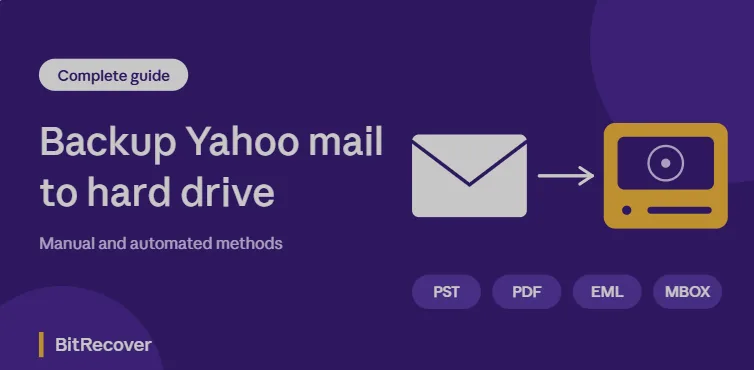
For many of us, a Yahoo inbox is a decade-long archive of invoices, travel bookings, work conversations, and family photos. Over the years, it quietly becomes a personal filing cabinet, and we rarely think about what would happen if it disappeared. Most people only start worrying when something goes wrong: an account gets locked, a password is compromised, or storage fills up and old emails start bouncing.
Yahoo is a cloud service, and a cloud service is not a backup. If you can’t log in, you can’t reach your data. That’s why keeping an offline copy on your own hard drive is one of the simplest and most effective ways to protect your digital life.
Why a Cloud Inbox Isn’t Enough
It’s easy to assume that anything stored online is automatically safe. In reality, your emails depend on one account, one password, and one company’s policies. A forgotten recovery email, a phishing attack, or a sudden security lock can leave you shut out for days or even weeks. Accidental deletion is another risk, because once a message is purged from the trash, it’s usually gone for good.
An offline backup removes that dependency. It gives you a copy that you control, that you can open without an internet connection, and that no policy change can take away.
Common Reasons to Back Up Yahoo Mail
- Account security: Hacking alerts and suspicious-activity locks can cut off access at the worst possible time. If someone gains access to your account, they could also delete messages before you notice.
- Storage limits: A full mailbox blocks incoming mail, and clearing space by deleting old emails risks losing something important. Archiving older messages to your hard drive lets you free up space safely.
- Switching providers: Moving to Gmail or Outlook is much easier when you hold a complete local copy. You can import it into your new account without worrying about missing folders.
- Records and compliance: Tax documents, contracts, invoices, and client emails should be stored somewhere you control. Accountants and legal advisers often ask for several years of records, and an online inbox isn’t a reliable archive.
- Inactive accounts: Yahoo can close accounts that go unused, along with their data. If you have an old address you rarely open, a backup protects the memories and documents inside it.
- Leaving a job or business: If a Yahoo address was used for work, you may need to preserve those conversations before access changes.
Manual Methods and Their Limits
There are a few free ways to save Yahoo emails, and they’re worth knowing about. Each one, however, has drawbacks that become obvious as soon as your mailbox grows.
1. Yahoo’s data request. Yahoo lets you ask for a download of your account data. It’s free, but the request can take days to process, and the result arrives as raw files that are hard to open, sort, or search. It’s better than nothing, but it isn’t a convenient archive.
2. Saving emails one by one. You can print individual messages to PDF or download them manually. This works for a handful of important emails, but it’s impractical for hundreds or thousands. It’s also easy to miss messages, and attachments can end up separated from the emails they belong to.
3. Email client sync. Adding your Yahoo account to Outlook or Thunderbird through IMAP creates a local copy of your mail. The catch is that large mailboxes often time out, some folders sync incompletely, and Yahoo requires an app password for third-party clients, which confuses many users. Even when it works, you’re left with a synced mailbox rather than a standalone backup you can store on a drive.
For small mailboxes and occasional needs, these methods can do the job. For anything larger, most people look for a more reliable option.
The Automated Approach
If you have a large mailbox or need an organized, repeatable backup, a dedicated tool is usually the fastest route. The BitRecover Yahoo Backup Tool, for example, connects directly to your account and saves your emails to your computer or external drive without requiring Outlook or Thunderbird to be installed.
When choosing any backup software, look for these features:
- Multiple output formats: Support for PST, EML, MBOX, and PDF means your backup can be opened in the application you prefer, or imported into a new email account later.
- Folder structure and attachment preservation: Your Inbox, Sent, Drafts, and custom folders should stay organized, and attachments should remain linked to their emails.
- Date filter and folder selection: Selective backup lets you save only the years or folders you need, which saves time and storage space.
- Bulk export: A good tool handles thousands of emails in one session instead of making you work message by message.
- A free demo version: Testing the tool on a few emails first lets you confirm the output before you buy.
The process is usually straightforward. You log in with your Yahoo credentials, choose the folders and an output format, select a destination on your hard drive, and start the backup. For a full walkthrough of both the manual and automated methods, see this step-by-step guide on how to backup Yahoo mail to hard drive.
Which Format Should You Choose?
The right output format depends on what you plan to do with the backup:
- PST is ideal if you use Outlook or want to import your mail into it later.
- MBOX works well with Thunderbird, Apple Mail, and many other email clients.
- EML saves each email as an individual file, which is handy for sorting and searching in a folder.
- PDF creates readable, easily shareable copies, which suits records for tax, legal, or compliance purposes.
If you’re unsure, saving a backup in two formats gives you extra flexibility.
Best Practices for a Reliable Backup
A backup is only useful if it works when you need it. These habits make sure yours does:
- Test your backup. Open a few saved emails and attachments to confirm everything copied correctly. Do this before you delete anything from your online account.
- Keep two copies. Store one on an external drive and another in a separate location, such as a second drive or encrypted cloud storage. A single copy can fail just like any other device.
- Back up regularly. A quarterly routine is enough for most people, and a date filter makes later backups quick because you only save new emails.
- Label your backups. Name folders with the account and date, such as “Yahoo-Backup-2026-10”, so you can find the right one later.
- Secure your account. Use a strong, unique password and two-step verification alongside your backups. Protect the backup drive as well, especially if it contains financial or personal documents.
Final Thoughts
Your emails hold more value than you might realize. They contain proof of purchases, important conversations, travel records, and memories you can’t recreate. A few minutes of preparation can save you from losing years of important data.
Whether you choose a manual method or an automated tool, the key is to act before you need the backup, not after. Start with a test on a small folder, check the results, and then back up the rest of your mailbox. Once you have a reliable offline copy and a simple routine, your emails will stay safe whatever happens to your account.



Leave a Reply