
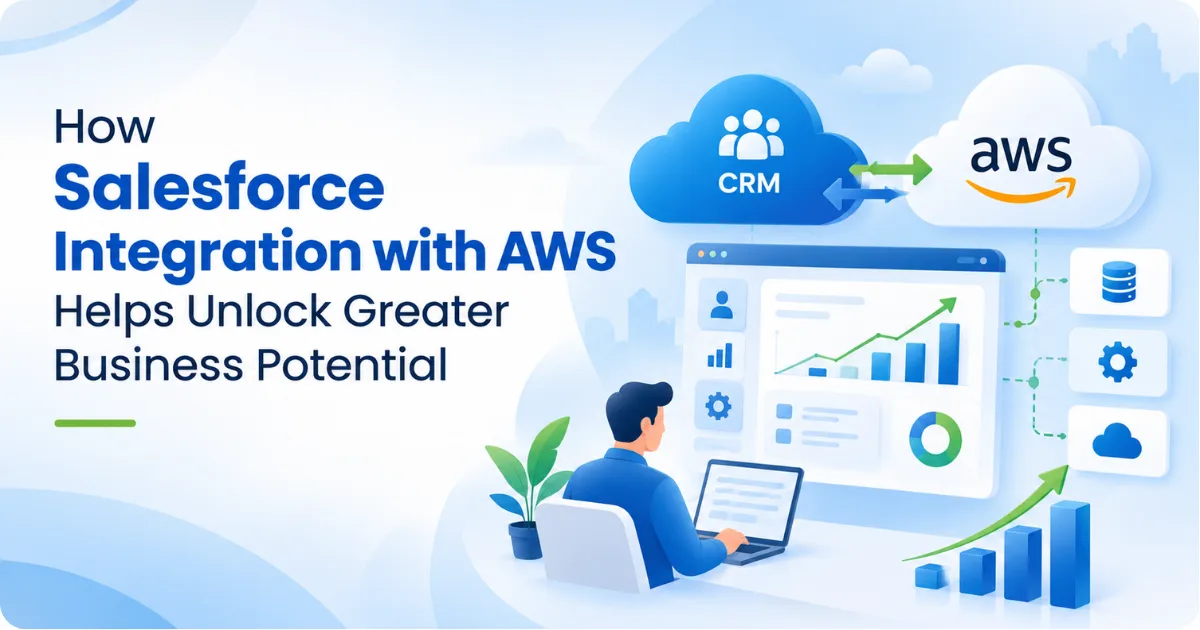
Salesforce integration with AWS unites your CRM with Amazon Web Services so that your customer data and computing power become inseparable. To be precise, you can perform more actions in Salesforce with the help of AWS services that will be used for storing, analyzing, and processing your customer data through AI and machine learning tools.
All companies have a wide variety of data stored in different places. Customer records are stored in Salesforce; some systems, files, and loads are stored in AWS. If those two places remain isolated from each other, the full picture is not seen because a support agent cannot access product usage data, and an analyst manually exports customer records from Salesforce. This means that while the data is present, it fails to reach the destination that it was expected to reach.
Integration of Salesforce with AWS resolves this issue: the data goes freely between these two systems, and each system does what it does best. Salesforce works with customer data, and AWS does all the hard work behind the scenes.
In this guide, we will talk about the Salesforce integration with AWS and what opportunities it brings. We will explain the advantages of using the integrated
What Is Salesforce Integration with AWS?
Salesforce integration with AWS can be described as the process of integrating your Salesforce CRM platform with AWS
Such integration goes beyond a mere connection. This integration enables you to make use of the storage, computing, analytics, and artificial intelligence services available through AWS using Salesforce.
The idea is to ensure that there is one seamless solution wherein your customer information and cloud infrastructure work together.
Why Businesses Connect Salesforce and AWS
Each platform is effective. When combined, however, the scope expands tremendously.
Organizations seek integration between Salesforce and AWS because it provides solutions to their challenges:
- Customer data stored independently of other systems
- Data transfer done manually between platforms
- Insufficient computing capabilities for analysis
- Opportunities to employ AI in analyzing customer data missed
- No holistic view of all organizational systems
The connection helps overcome these hurdles. Data gets where it is needed, while the organization gains the full picture.
Benefit 1: A Fuller View of Every Customer
Excellent services require knowing about the customer. However, there is no single platform that contains all the information.
Integration of data from AWS into Salesforce ensures that not only CRM information is visible to teams but also additional data about product usage and app activities.
- With such an enhanced view of the customer, you can:
- Understand the customer’s actual use of your product
- Identify their needs and issues earlier
- Personalize services with the help of the context
- Make decisions with complete information
A richer profile means smarter, more relevant interactions at every step.
Benefit 2: More Power for Data and Analytics
Salesforce CRM does a good job in handling relationships. AWS is packing a serious punch when it comes to heavy data.
You can use your Salesforce data for large-scale analysis on AWS by linking the two. This is increasing your visibility without straining your CRM.
This additional power enables you to:
- Quickly analyse large data sets
- Scale data storage effectively at a scale.
- Construct reports using many sources
- Grow without performance concerns!
You gain the benefit of a large data system, linked to your customers’ records.
Benefit 3: Smarter Apps with AI and Automation
AWS has a variety of AI and machine learning tools. Those tools can be pointed to your Salesforce data with the power of integration.
This creates an opportunity to offer smarter, automated solutions. Predictions, recommendations, and automation are all achievable.
For instance, a company could:
- Forecast customer churn or attrition
- Make the next best suggestion
- Automate routine data processing
- Make apps smarter for the customer. Make apps smarter for the customers.
Your CRM stops being simply a book and becomes an action guide.
Benefit 4: Reduced Manual Labor, Fewer Mistakes
Manual data movement is tedious and error-prone. All manual exports are prone to errors and time-consuming.
When Salesforce integration services are implemented, data automatically syncs from one platform to the other. All changes in one system are reflected in the other without any actions.
The outcome is improved, faster running, and cleaner:
- No more manual data transfers!
- Reduced errors due to copy-paste tasks
- Real-time, consistent information
- More time for valuable work
Automation here saves you time from having to deal with data entry instead of customers.
How to Approach the Integration
The integration is well planned, not rushed. Begin at the end and work backward.
Keep in mind the following rules:
- The business objective should be defined first, followed by technology.
- Link your data of most value first
- Establish security and access policies
- Test thoroughly before broadcasting.
It pays to focus on a start. The connection can always be expanded after the first win has been determined.
FAQ
1. What is Salesforce integration with AWS?
It refers to the process through which Salesforce CRM can be integrated with Amazon Web Services.
2. What makes Salesforce integration with AWS a must for a business?
To do more with customer information. The integration provides a more comprehensive view of customers, introduces computing and AI capabilities, and eliminates manual data movements between systems.
3. What are the pros of Salesforce AWS integration?
All of this results in better decisions, more efficient operations and less manual effort with a complete customer view, better analytics, and smarter AI-driven apps.
4. Is Salesforce integration with AWS secure?
With the proper configuration, it can be. Data is secure as it transits between platforms with access rules, permissions, and careful planning.
5. Is this an advantage for small businesses?
Yes. With just a single perspective of data and access to AWS’ scalable tools that are paid by usage, even small businesses benefit from this.
Conclusion
You already have valuable data in both Salesforce and AWS. The true promise is in the linking of them. The power of the cloud combined with customer information provides a richer view, more insight, and smarter tools all built on one unified foundation.
However, integration does not provide any more value than it is designed to. Planning is key to getting it right, interpreting the right data and ensuring it’s all in place, and good guidance makes all the difference. An inadequate connection could lead to data inaccuracies or vulnerabilities, not advancements.
If you’re looking to get this right, then you are going to want to select a Salesforce service partner wisely. Seek out someone with real-world experience rather than certificates that have been obtained on paper, with experience in AWS and Salesforce integration services. Find out how they’ve integrated these platforms for companies like yours, how they’re dealing with data security, and how they can help you after go-live. A good partner begins with objectives, remains in position for the first phase, and continues to journey along with you as you develop. The most successful ones don’t feel like a vendor — they feel like it’s your team.


Leave a Reply