
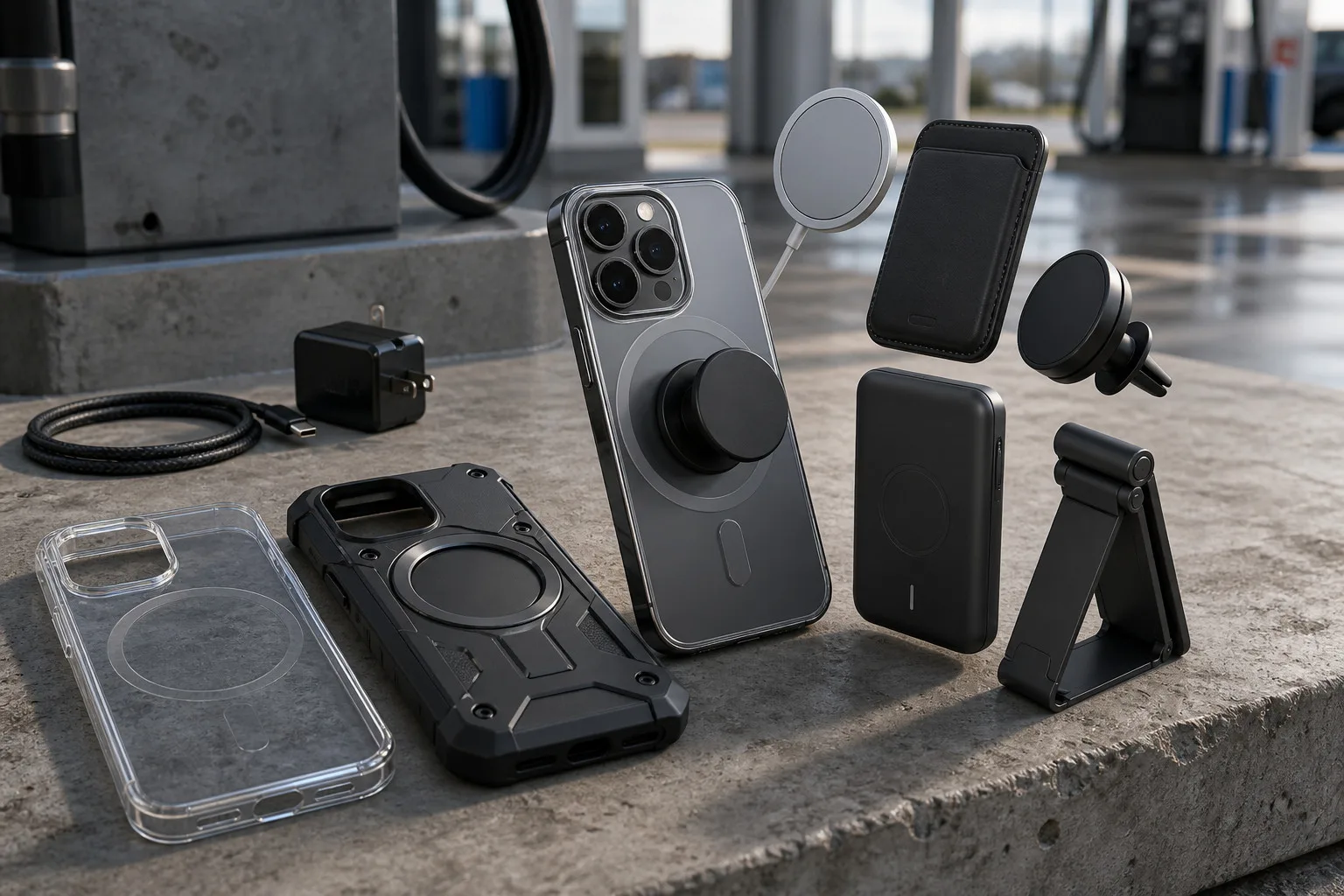
I dropped my phone at a gas pump in February. Not a dramatic drop — no bounce, no slow-motion tumble, just a flat six-inch slide out of my fingers onto a concrete island while I was reaching for the nozzle with my other hand. It survived. The case did not, and neither did my patience.
Here’s the detail nobody warns you about: an iPhone 17 Pro Max weighs 233 grams. That’s a half pound of titanium and glass balanced on four fingertips, 163 millimeters tall, and the moment you tilt it past a certain angle it stops being a device and starts being a physics problem. Android flagships aren’t any kinder. We spent fifteen years asking for bigger screens and we got them, and now we’re all quietly performing this little claw maneuver every time we try to reach the notification shade one-handed.
So I did what any reasonable person does. I bought a bunch of accessories and tested them for six months.
The part everyone skipped past
While we were all arguing about camera bumps and AI features, something structural happened to phones: the ring of magnets under the back glass turned into a platform.
That’s not marketing talk. The Wireless Power Consortium rolled out Qi2 25W — you’ll also see it written as Qi2.2 — back in April 2025, and the whole thing hinges on a Magnetic Power Profile that physically snaps the coil into alignment before a single watt moves. MPP 2.0, if you want the acronym. The magnets aren’t a convenience feature bolted onto wireless charging. They are the mechanism. Alignment is what lets 25 watts flow without the coil cooking itself, and alignment is only reliable because something is holding the two halves in register.
Which means the magnet array on your phone is now doing double duty. It aligns your charger. And it’s a universal mounting rail that every accessory maker on earth has agreed to build against.
That second job is the one worth arguing about.
Grips: the accessory I was most wrong about
I want to be honest about my starting position here, because I was snobby about it. For years I thought stick-on grips were for people who didn’t care what their phone looked like. Adhesive pads, permanent commitment, a lumpy disc that wrecks the line of an otherwise nice device, and a residue ring left behind when you finally peel it off. Hard pass.
Magnets fixed that entirely, and I was slow to notice.
A modern magnetic grip clicks on, holds through a case, and comes off clean when you don’t want it. No adhesive. No residue. Nothing permanent. You can pull it off before you drop the phone in a pocket and snap it back on when you’re walking through a parking lot. The good ones fold nearly flat — the magnetic phone grip options that made my shortlist all live somewhere between 2.5 and 4 millimeters when closed, which is thin enough that the phone still lies flat on a table and still charges through the grip without you taking anything apart.
Griplux’s Luxi Snap Grip is the one that’s been on my phone since spring. 2.8mm, 14.4 grams, slide-and-lock rather than an elastic strap, and it doubles as a kickstand for video calls I’d rather not hold up for forty minutes. Thirty-two bucks. There are cheaper ones. I’ve used a few, and the failure mode is always the same — the magnet is fine, but the hinge or the strap gives out around month three.
Does it look like an accessory? Yes. Obviously. But I stopped pretending that a phone I have to hold like a wine glass is somehow more elegant than one I can actually use.
Your case is either helping the magnet or fighting it
This is where most of us accidentally sabotage the whole arrangement, and it took me an embarrassingly long stretch to work out why my grip kept creeping sideways.
Magnetic force falls off fast with distance. Not linearly — fast. Every extra millimeter of plastic between the phone’s magnet array and whatever you’re snapping onto it costs you meaningful holding power, and a chunky 3mm case with no magnets of its own is basically an air gap wearing a costume. You get a grip that holds until you tug it sideways in a coat pocket, and then you’re on your knees in a parking garage.
Two ways out. Either the case has its own magnet ring built in, or it’s thin enough that the phone’s own magnets reach through it. Thin cases in the 0.4 to 1mm range let the native array do the work with barely any loss, which is why an ultra thin phone case has quietly become the enthusiast pick over the big armored stuff — you keep the phone’s actual dimensions, you keep the magnet strength, and honestly, you keep the color you paid extra for.
The tradeoff is real, and I’m not going to pretend otherwise. A 0.5mm shell will not save your screen from a face-down landing on asphalt — what you’re buying is edge coverage, scratch defense, and maybe a whisper of shock absorption, and that is the entire list. Job site? Buy the armored case, accept the weaker magnets, get on with your day. For everyone else — and I’d argue that’s most of us — the thin case plus a grip you can actually hold is the better trade, because the accessory that prevents the drop beats the accessory that survives it.
The charging half of the same idea
A second shift happened in parallel, and it’s easy to overlook because it looks so dull from the outside.
Gallium nitride. GaN, if you’ve seen the sticker on a brick and wondered. It’s a semiconductor material that switches faster and runs cooler than the silicon in your old wall wart, and the practical result is that the physical brick shrank by something like half while the output went up. The 30-watt hockey puck that used to occupy two outlet slots now fits between them.
That matters more than it sounds, because Qi2 25W has a hidden prerequisite: you need a USB-C Power Delivery adapter rated 30W or better to actually see those speeds. A lot of people buy the magnetic charging puck, plug it into whatever 20W brick came with a phone from 2021, and then complain that wireless charging is slow. It’s not the puck. It’s the wall.
I’ve been running one GaN charger for the laptop, the phone, the tablet, and my partner’s headphones, and the single-brick thing has done more for the state of my bag than any organizer I’ve ever bought. Multi-port GaN units in the 100 to 160W range split power intelligently across devices, so the laptop pulls what it needs, and everything else fills in around it. One brick. One cable if you’re disciplined, which I’m not.
What still bugs me
Nothing here is finished. Magnet strength varies wildly between brands, and almost nobody publishes an actual figure in newtons, so you’re buying on vibes and review scores. Qi2 25W support on Android is still patchy in a way that makes buying advice annoying to give. And a grip is one more thing to lose, which I have done, twice, both times in a rental car.
But the direction is clear enough. The back of your phone stopped being a surface and became a port. Grips, wallets, stands, tripods, car mounts, battery packs, chargers — all of it snapping to the same annulus of magnets, all of it removable in a second, none of it demanding adhesive or a lifelong commitment.
Which raises a question I keep coming back to. If the magnet array is now doing this much structural work, why is it still the one spec that never appears on the box?





Leave a Reply