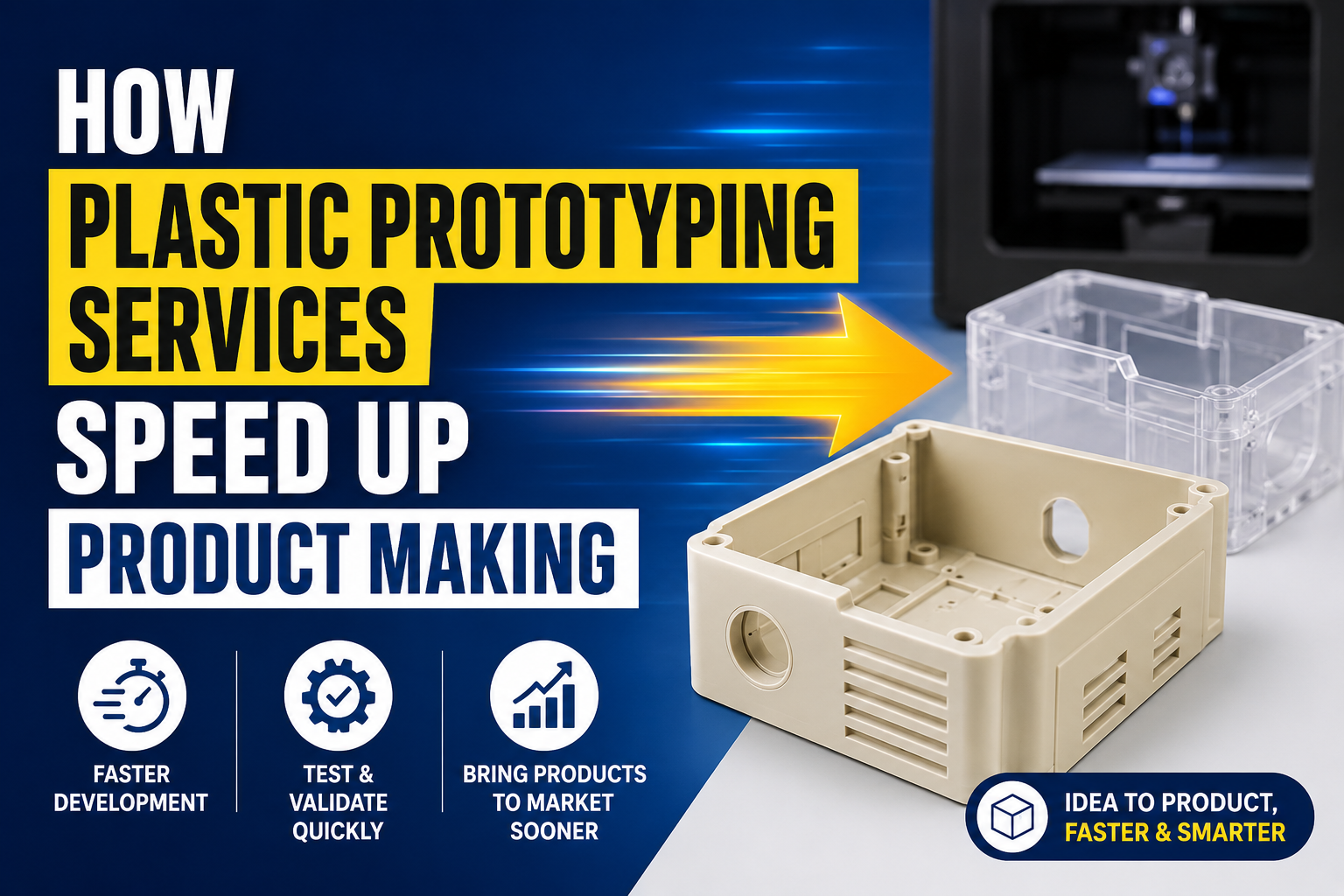
In today’s manufacturing world, nothing matters more than speed. A product launch delayed by even a couple of weeks hampers your market share and hurts returns. The point where most timelines fall apart is prototyping—the link from a digital design to a physical product.
For engineers and product designers, plastic prototyping services are now a must, not a luxury.
They shrink development cycles, find problems early, and verify function before costly tooling begins. This blog covers how plastic prototyping makes validation quicker, drops risk, and eases the journey from a sketch to store shelves.
Defining Plastic Prototyping Services
Plastic prototyping services give you different ways to get physical models of plastic parts before you start mass production. You’ve got additive options such as 3D printing, subtractive ones like CNC machining, and transitional methods like soft tooling. The main point is to end up with a working part that behaves like the final injection-molded version—same material feel, same strength, same shape.
Unlike visual models, these get tested under real conditions. Functional prototypes let you run failure analysis, check assembly fit, and do regulatory tests. Ultimately, plastic prototyping services save months of rework by ensuring that the design is right before the high-volume production line ever starts.
How Rapid Prototyping for Plastic Parts Cuts Timelines
Time is the most expensive variable in product development. Traditional methods, such as waiting for hard tooling, often took 10-14 weeks just for the first sample. Modern rapid prototyping for plastic parts shrinks that timeline down to just days. With quick back-and-forth cycles, a team can test, break, and fix a design all in one week.
Rapid prototyping lets engineers make a real part within 24 to 48 hours after finishing a CAD file. That speed helps catch things like poor fits, bad draft angles, and sink marks—issues that software often misses.
Moreover, it allows parallel work: marketing can test the prototype while engineering adjusts the mold design. Without this pace, a single design mistake might only show up after the mold is already cut, which means expensive fixes and launch delays. Rapid prototyping basically removes the guesswork, so the first production run is also the right one.
Comparing 3D Printing vs Injection Molding for Prototypes
A common strategic debate in product development centers on 3D printing vs injection molding for the prototyping stage. Which one you pick depends on how many parts you need and what the prototype is for.
Looking at 3D printing vs injection molding: 3D printing is great for checking shape and fit, plus complex shapes you can’t machine. No tooling required, so it works well for the first two or three tries. But when you compare 3D printing vs injection molding for material strength, injection molding gives you parts that are truly strong in all directions and use real production plastics. The trick is knowing when to make the switch.
Table 1: 3D Printing vs Injection Molding at a Glance
| Feature | 3D Printing Prototyping | Injection Molding Prototypes |
|---|---|---|
| Lead Time | 24 hours to 3 days | 10 to 20 days (aluminum tooling) |
| Material Properties | Near-production (limited isotropy) | True production-grade strength |
| Best For | Form/fit testing, complex geometry | Functional testing, pilot runs |
| Per-Part Cost | High volume | Low in volume |
The Power of Rapid Tooling and Bridge Tooling
After the design is finalized, the focus moves to testing at scale. This is when bridge tooling and rapid tooling become really useful. Rapid tooling is about getting mold inserts fast—using aluminum or 3D-printed cores, for example. That gives you hundreds to thousands of parts without the cost of steel molds.
Meanwhile, bridge tooling works as a temporary setup while the permanent molds are still being machined. It lets a company launch a product, collect market feedback, or fill early pre-orders using softer tooling.
Rapid tooling and bridge tooling are often used side by side: one for prototype parts, the other for the first sales inventory. By using bridge tooling, PLASTIC INJECTION MOLDS helps clients see revenue up to eight weeks sooner than if they waited for hard production molds.
3D Printing Prototyping for Complex Geometry
While bridge solutions handle volume, 3D printing prototyping handles complexity. If your part has internal lattices, conformal cooling lines, or organic shapes, printing prototyping is the best choice. It develops things layer by layer, so you can include features that would normally require multiple slides or lifters in a traditional mold.
The prototyping really works well with medical devices, drone components, and complex housings where you’d rather not deal with assembly. PLASTIC INJECTION MOLDS brings in 3D printing prototyping early in the process to check assembly sequences before committing to steel. On top of that, 3D printing prototyping allows overmolding and snap-fit testing with actual production materials such as ABS, Nylon, or TPU.
Journey from Prototypes to Production
The ultimate goal of any prototyping effort is seamless transition. Making injection molding prototypes is the final verification step before mass manufacturing. Unlike additive parts, injection moulding prototypes use the same resin, the same gate locations, and the same ejection methods as the final product.
This eliminates “scaling surprises” where a 3D-printed part works but a molded part fails. Injection molded prototypes typically use single-cavity or aluminum molds to generate 50 to 500 parts for beta testing, regulatory approval, and pilot runs.
Once those injection molding prototypes pass all metrics—dimensional reports, drop tests, thermal cycling—the design is frozen. This leads directly to the prototype to production transition. A smooth prototype to production handoff requires that the prototyping data match the production tooling data perfectly.
Conclusion
Speeding up product development isn’t about skipping steps. It’s about doing things in the right order. From the first thought to the finished part, plastic prototyping services help you stay ahead of the competition. PLASTIC INJECTION MOLDS works on exactly this kind of process—pairing rapid tooling with longer-term production goals.
Moving from rapid prototyping for plastic parts to final injection molding prototypes calls for a partner who knows how materials behave and how long tooling takes. Remember: the cheapest prototype is the one that doesn’t need a second version.
When you use plastic prototyping services the right way, the step from prototype to production turns into one smooth move. Don’t let tooling delays set your launch schedule.
CTA
PLASTIC INJECTION MOLDS provide dedicated support for bridge tooling and high-volume validation. Visit the company to request a rapid quote and turn the design into reality faster. Call (647) 294-5240
Or email to info@plasticinjection-molds.com





Leave a Reply