
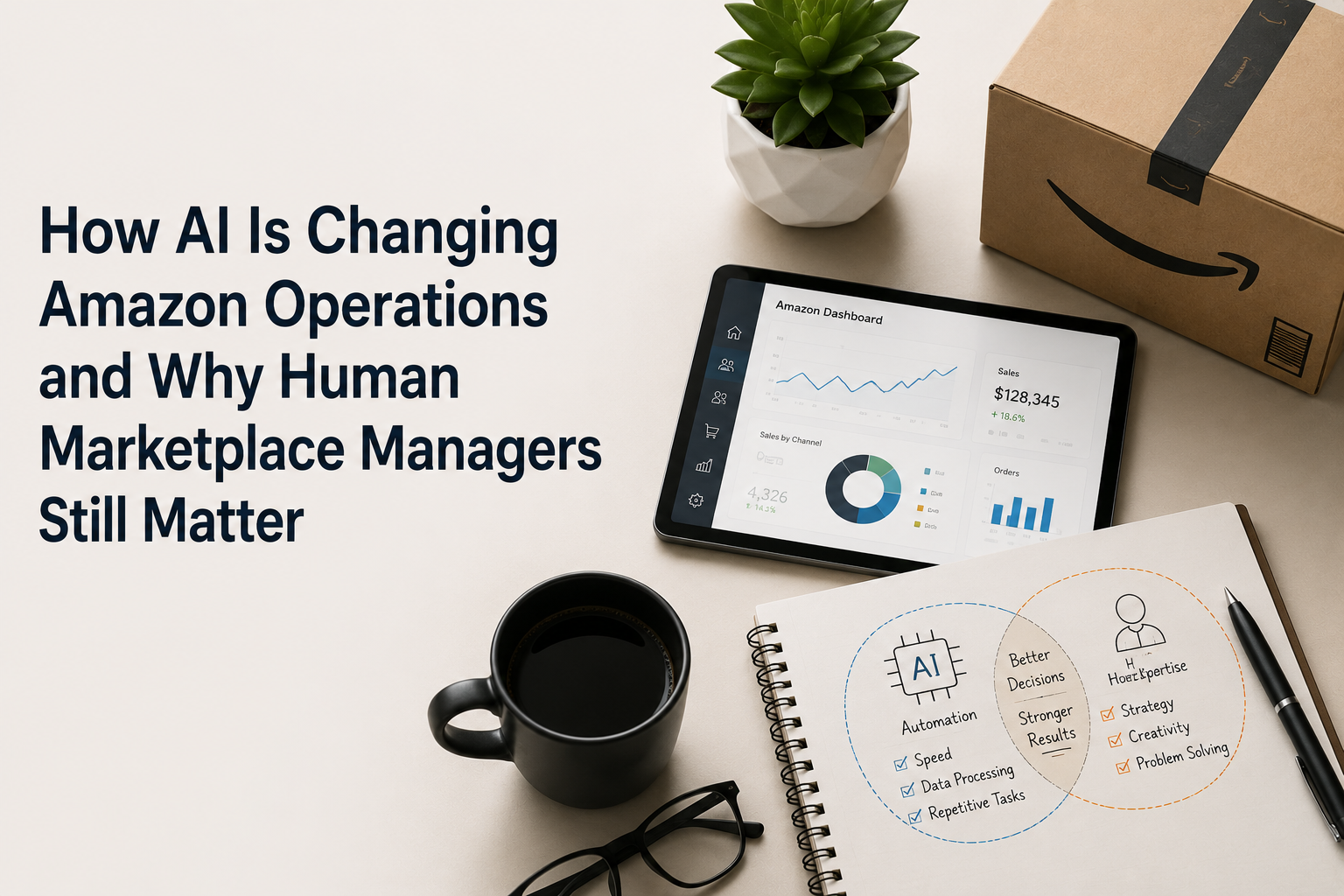
| “Automate everything that doesn’t require high judgment.” – Dr. Werner Vogels, CTO, Amazon |
That principle is becoming the operating model for Amazon sellers. AI now supports listing creation, campaign optimization, pricing, FBA inventory planning, and account-health monitoring. The benefit is not just scalability but also the ability to manage more ASINs, performance signals, and frequent marketplace changes without increasing manual effort.
However, sustainable Amazon account management still relies on the decisions that automated systems cannot make. Amazon sellers must ensure that the automated operations keep brand voice in check, fit the marketplace context, attract the right buyers, protect margins, align inventory with demand, and safeguard account health.
The shift toward AI raises a more important question for sellers: where should automation stop and expert control begin?.
Amazon Marketplace Operations: What AI Automates and Where Human Expertise Is Required
1. Amazon Product Listing Optimization & Catalog Management
What AI Automates
For sellers, manually creating and optimizing thousands of product detail pages adds a significant amount of time to catalog operations. Automation now absorbs that workload across three areas:
- Data Mapping & Categorization: Automated feed ingestion pulls product data from multiple suppliers or regions, standardizes attributes and units, and maps each product to the right product type, attributes, browse nodes, and tags. However, automation maps products based on best match, and a specialist performs the final accuracy check before submission.
- Content Generation: Amazon’s generative AI tools draft titles, bullet points, descriptions, and product attributes using seller-provided product information or images. For existing listings, Enhance My Listing analyzes customer shopping and engagement signals to recommend updates to titles, descriptions, attributes, and missing details. Sellers can review and edit the generated content before publishing it.
Source: Amazon - Catalog Quality Monitoring: Automated checks flag duplicate product listings, missing or inconsistent attributes, listing errors, invalid parent-child variant relationships, and potentially non-compliant content. They surface these issues for catalog specialists to verify and correct before submission to avoid listing suppressions.
- Visual Assets Creation: Amazon’s generative AI creative tools can place existing product images into lifestyle or brand-themed settings and produce variations for advertising campaigns. This reduces the need for individual photoshoots for every campaign, offering brands a cost-effective alternative.
Source: Amazon
Where Expert Review is Essential in Catalog and Product Listing Management
AI can generate and recommend listing content, but sellers remain responsible for verifying its accuracy, compliance, and commercial relevance. That responsibility covers several areas:
- Accuracy and Context: AI can generate incorrect specifications or rely on outdated source information. A specialist verifies dimensions, materials, sizing, compatibility, included components, and feature details against current manufacturer records, approved packaging, and technical documentation. This reduces returns and customer complaints caused by inaccurate or incomplete product information.
- Regulatory and Marketplace Compliance: Generative AI can produce plausible but unsupported claims, so a specialist validates them against applicable Amazon policies and category-specific regulatory requirements, including FDA requirements or CPSIA obligations where relevant, before they trigger a suppression or suspension.
For example, claims such as “clinically proven,” references such as “FDA approved,” ranking statements such as “#1 best-selling,” and specifications that lack supporting documentation.
- Brand Consistency: A specialist establishes the brand voice, messaging framework, visual standards, and product positioning that guide AI output. The specialist then validates generated titles, A+ Content, and imagery for factual validation, strategic brand positioning, and compliance with Amazon’s content and image requirements.
2. Amazon PPC Management
What AI Automates
At unBoxed 2025, Amazon introduced Ads Agent, a conversational assistant accessed through a chat window on certain Amazon Ads pages. It acts at the advertiser’s direction and supports campaign orchestration rather than always-on bidding:
- Create and Optimize Campaigns at Scale: Upload a media plan, and Ads Agent builds the campaign structure and ad groups, or optimize existing campaigns at scale through natural-language commands.
- Campaign Targeting: Ads Agent reviews thousands of audience segments to recommend the most relevant segments and keywords, which you review, refine, and apply.
- AMC Insights: When you ask a question in plain language, the Ads Agent writes the complex audience and analytics SQL that Amazon Marketing Cloud runs, with real-time guidance to simplify the analysis.
Rules-Based and Algorithmic Automation: Amazon’s native bidding controls and third-party PPC platforms optimize Sponsored Ads continuously within limits you set:
- Bid Optimization: Dynamic and rule-based bidding raises or lowers bids by conversion probability, adjusts them by placement (top of search versus product pages), and can steer spend toward a set ACoS or ROAS target.
- Dayparting: Automated rules concentrate spend on the hours and days a product converts and keep campaigns from exhausting the budget early.
Source: Amazon - Search-Term Harvesting and Negative Targeting: Automated systems evaluate customer search terms against advertiser-defined thresholds for sales, conversion, ACoS, and wasted spend. It moves search terms that generate sufficient sales at an acceptable cost into exact-match keywords for tighter bid control. It also adds irrelevant terms, or those that exceed set thresholds without converting, as negative keywords to prevent further inefficient spend.
Ad Copy and Creative Generation: Amazon ads AI creative tools create ad copies, images, and video variations from seller-provided product information and brand assets. Sellers can use these variations across eligible ad formats for A/B testing.
Where Human Expertise Is Required in Amazon PPC Management
- Profit Margin: The Amazon PPC specialist sets break-even and target ACoS from each product’s profit margin, after referral fees, fulfillment, storage, discounts, and returns. In parallel, the specialist tracks TACoS as an account-level check on whether advertising supports total sales growth rather than only attributed revenue.
- ASIN Launch Strategy: Newly launched ASINs have no conversion history, which limits performance-based automation. A specialist sets the initial bids, budgets, targeting, and placement, then monitors them as search-term and conversion data accumulates.
- Root-Cause Diagnosis: A specialist checks whether rising ACoS comes from bidding pressure or changes in price, reviews, delivery, or Featured Offer status. This prevents PDP gaps from being misdiagnosed as campaign problems, protecting conversion, advertising efficiency, and sales.
- Campaign Budget Allocation: A PPC specialist determines how the total campaign budget should be split across product launches, live ASINs, seasonal demand, and inventory clearance.
- Search-Term Relevance: Automated harvesting promotes search terms that clear performance thresholds. A specialist still checks whether those terms match the product, customer intent, price positioning, and campaign objective.
- A/B Testing and Creative Review: A PPC specialist defines the element being tested and keeps bids, targeting, placement, and budgets consistent. The specialist then compares CTR, conversion rate, and ROAS to identify the stronger creative and confirm that it remains accurate, relevant, and aligned with the brand.
3. Dynamic Pricing and Featured Offer Management
What AI Automates
Amazon’s Automate Pricing tool adjusts prices in near real time according to rules set by the seller to improve price competitiveness and increase the likelihood of becoming the Featured Offer.
- Competitive Price Adjustment: Sellers can compare prices against the Featured Offer, the lowest price on Amazon, or the lowest external price.
- Demand-Based Repricing: Automated repricing tools adjust prices according to the number of units sold over a defined period, responding efficiently to shifts in sales velocity.
- Margin Guardrails: The tool automatically repositions prices based on market conditions, but operates within the seller-defined minimum and maximum prices. This ensures automated changes never fall below an acceptable profitability threshold.
Role of Manual Oversight in Automated Pricing
- Setting Price Thresholds: A campaign manager sets the minimum price limits, which account for referral fees, FBA fulfillment and storage fees, return rates, and the advertising spend allocated to the ASIN. This ensures that the Featured Offer is not secured at a loss.
- Minimum Advertised Price (MAP) Compliance: For products subject to MAP restrictions, a specialist sets the agreed price as the minimum repricing threshold. This prevents the seller’s automated price from falling below MAP.
- Pricing Controls: Amazon flags sharp deviations from an established price history and can deactivate the offer until the seller corrects it. A campaign manager monitors pricing movements to prevent such deviations.
4. FBA Inventory and Demand Forecasting
What AI Automates
Amazon’s agentic Seller Assistant monitors FBA inventory, identifies slow-moving products, and recommends whether sellers should retain, discount, or remove them. It also analyzes historical sales and current demand patterns to prepare shipment plans and recommend inventory allocation across FBA and Amazon Warehousing and Distribution.
For example, when a seller asks why FBA storage usage is increasing, Seller Assistant analyzes inventory age and storage utilization. It then explains the underlying causes and recommends actions to reduce excess stock and storage costs.
Source: Amazon
Where Human Expertise Is Required in Amazon Inventory Optimization
- Predictive Analysis Accuracy: A marketplace specialist reviews AI recommendations against supplier lead times, confirmed inbound stock, promotions, and product lifecycle plans before changing replenishment quantities.
- Inventory Prioritization: When storage capacity or working capital is limited, the specialist determines which ASINs receive priority based on margin, seasonality, and expected demand.
- Cross-Functional Coordination: Inventory risks may require changes to advertising, pricing, promotions, or shipment timing. A specialist coordinates these actions to limit excess stock and avoid unplanned stockouts.
5. Amazon Account Health Management
What AI Automates
Amazon’s agentic AI Seller Assistant continuously monitors account health, policy risks, and customer service metrics. It can explain what triggered a warning and recommend corrective actions.
- Proactive Risk Detection: Seller Assistant flags product safety concerns, noncompliant listings, and performance metrics approaching warning thresholds.
- Issue Analysis and Resolution Support: When a seller requests an account-health summary, the system identifies urgent issues and explains their likely cause. It can also present resolution options and implement an approved action.
Source: Amazon
The Role of Manual Oversight Is Essential in Account Health Management
- Corrective Action Review: A marketplace specialist checks whether the proposed action addresses the actual issue without creating additional catalog, compliance, or sales risks. The specialist also confirms that the proposed listing changes accurately represent the product and comply with applicable laws and Amazon policies.
- Documentation and Evidence Review: Product-safety, regulatory, category-approval, and authenticity cases may require invoices, certificates, test reports, or registration details. A specialist verifies that the submitted evidence matches Amazon’s request.
- Appeals and Escalations: Automated guidance can help sellers understand an issue, but disputed restrictions and account actions still require case-specific judgment. A specialist investigates the root cause, prepares the response, and manages escalation and appeals through Amazon Seller Support.
In Summary: The Human-in-the-Loop Operating Model
| Operational Area | What Automation Handles (Volume) | Where the Specialist Leads (Final Check) |
| Listing & Catalog | Feed mapping and categorization, content generation, catalog quality checks, lifestyle image variations | Accuracy against source records, regulatory and claims compliance, and brand consistency |
| PPC Management | Bid optimization, dayparting, search-term harvesting, and negatives; Ads Agent campaign builds, targeting, and AMC queries | Profit-based ACoS and TACoS targets, launch strategy, root-cause diagnosis, budget allocation, search-term relevance |
| Pricing & Featured Offer | Competitive and demand-based repricing within minimum and maximum guardrails | MAP compliance, pricing deviation monitoring |
| FBA Inventory & Forecasting | Inventory monitoring, slow-mover identification, shipment, and allocation recommendations | Forecast validation against lead times and inbound stock, inventory prioritization, and cross-functional coordination |
| Account Health | Continuous monitoring, risk detection, issue analysis, and guided resolution | Corrective-action review, documentation and evidence, appeals, and escalations |
Beyond these five core functions, Amazon account management spans several other specialist-led operations, including customer support, order management, and refund and return handling. Automation can execute the repetitive tasks in each operation, such as routing messages or flagging return patterns, but the resolution, judgment, and account-health impact of these tasks continue to sit with experienced specialists.
How Amazon Sellers Should Approach Amazon Account Management to Stay Ahead
The business value of AI in Amazon operations lies in faster processing, lower operating costs, stronger margin control, and greater capacity to scale. These gains depend on how sellers combine automation with marketplace expertise.
The right approach: Let automation enhance operational capacity while leveraging specialists’ review to determine which actions support business objectives, establish brand positioning, and enhance customer experience for long-term growth.
- Establish Controls and Standardize Rules: Define which actions automation can execute and which require specialist approval. Apply consistent thresholds, review criteria, and escalation rules across marketplace functions.
- Apply Cross-Functional Marketplace Oversight: Use specialists to review exceptions and monitor how automation affects advertising, pricing, inventory, listings, compliance, and account performance.
- Choose Between In-House vs. Outsourcing: When internal resources are limited, partner with Amazon account management services to access field-level expertise, cost-effective solutions, technical infrastructure, and scalability.
The sellers who scale profitably are not the ones who leverage automation aggressively, but those who define where automation ends and expert judgment begins, and build their operation around that strategy.





Leave a Reply