
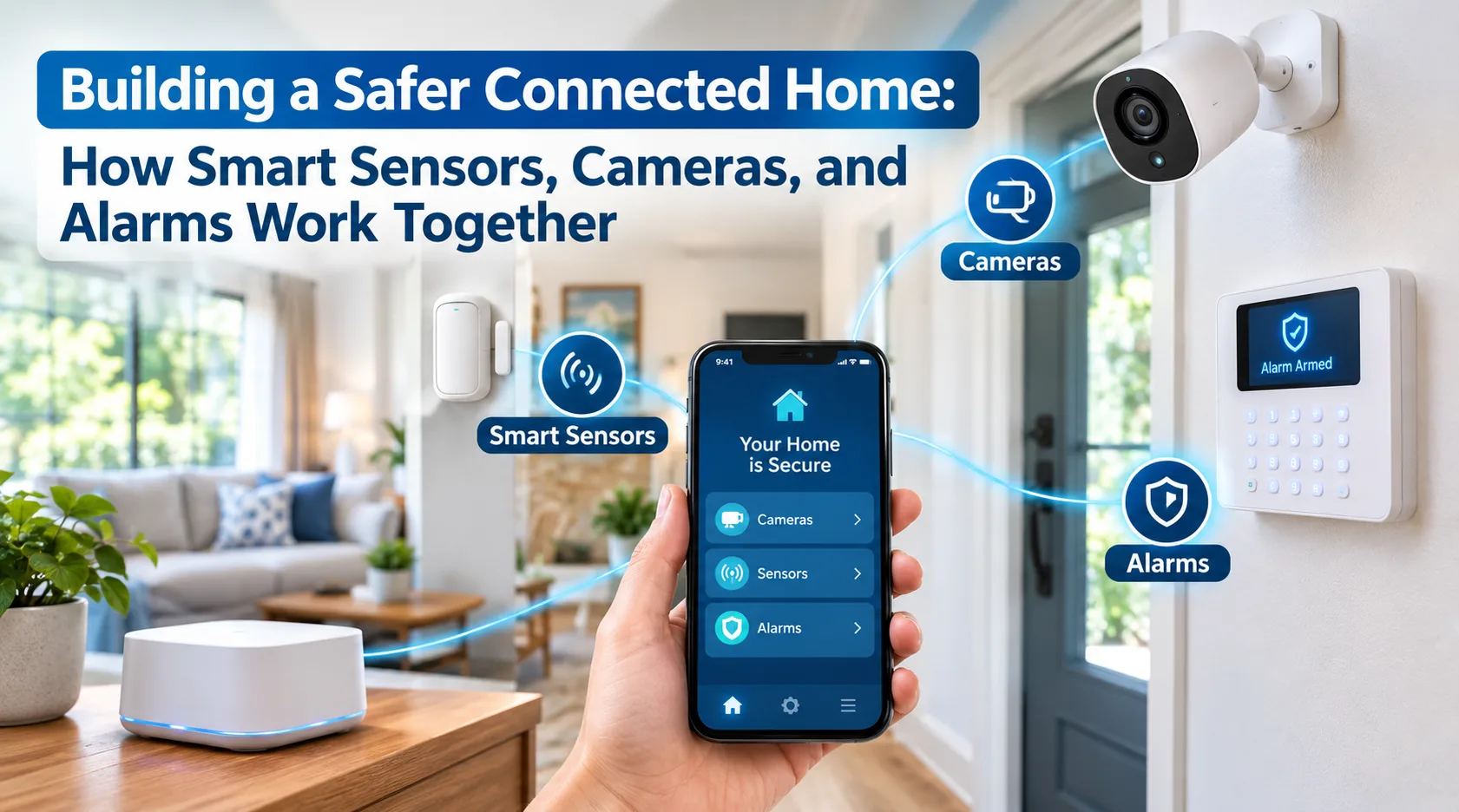
The current-day home is growing more connected due to the fact that there are many sensors, cameras, alarm systems, smart locks, lighting control systems, and other gadgets that are able to communicate using home networks. Not only have they ceased to work as separate devices, but now they have become a part of the security environment that is able to detect suspicious behavior, analyze the data, and give warnings to those who live in the house.
This new trend influences the way in which homeowners secure their property. While traditional systems worked using separate alarms and cameras, the connected ones use several different sources of information in order to provide a bigger picture of the situation going on at a property.
Connected Security Moves Beyond Individual Devices
A typical home security system is made up of three significant aspects: detection, verification, and response. Detection is carried out by sensors; cameras give visual feedback, and the alarms or connected apps give out alerts to the homeowners. Integration makes the process of using a security system beneficial in that it depends on how these components are interrelated. While a sensor can detect an opening in a door, the presence of a camera around the area can give visual feedback regarding the event.
The smart sensors are the first step in making the system integrated. The various sensors are used to monitor different physical aspects, such as motion, openings in doors and windows, broken glass, smoke, water leakage, temperature, among others.
Smart Sensors Provide the First Layer of Detection
Sensors are necessary as they are constantly monitoring conditions that might be hard for the occupants to keep track of manually. Motion sensors detect any movement in an area, whereas contact sensors recognize changes in status, such as whether there was an opening of doors and windows.
Information obtained through sensors becomes more helpful when multiple sensors work together. Different actions will be taken for movement detected after the opening of the door than for movement detected in the home, especially where there is inclusion of schedules and presence information.
Several Sensor Functions Contribute to A Connected Security Environment:
- Access Detection: Door and window sensors detect changes in access points and give early warnings about any unwanted entry into a building. When used in conjunction with other devices, these signals provide context to the notification rather than acting as individual alerts.
- Motion Detection: Motion sensors detect movement in selected locations and aid in detecting any unwanted movements. For their effective operation, proper placement and appropriate sensitivity settings are important.
- Environmental Detection: Smoke, heat, water leak, and temperature sensors provide a broader scope of home security systems. This equipment detects hazards in the house that can cause damage regardless of the presence of any unwanted intruder.
Connected Technologies Build a Layered Home Security System
Connected home security involves integrating several components like sensors, cameras, and alarms in order to generate several levels of surveillance and reaction. Every device plays a unique role, while the combination of all those elements offers more insight into the events happening at home.
· Cameras Add Visual Context to Sensor Alerts
While sensors detect an occurrence in most cases, the reason behind the event is usually unclear. Images captured by cameras assist inhabitants to learn about the activities that are going on at the entrances, rooms, garage, or other parts being monitored. Modern connected cameras can have motion detection, night vision, two-way audio, cloud or local storage, and mobile notifications among other features. Some camera systems analyze images for different kinds of movements through software, but the effectiveness of these functions depends on the specific camera model and other environmental factors.
Camera deployment location becomes very relevant since outdoor cameras may be dedicated to monitoring of entrances, driveways, and boundary lines while indoor cameras should be deployed taking into account household privacy, access permissions, and recordings.
· Alarms Convert Detection into Immediate Action
The alarms form the part of the response element of the security system. This is because the siren, portable alert, flashing light, or SMS tells us that some event has been detected. The connection between detection and response becomes very important for the security system. For example, in case of any unauthorized entry through the door, detected by the contact sensor, the alarm will be triggered from the security system. In case of a fire situation detected by the smoke detector, the response will be the generation of an alarm.
In addition, interconnected alarms lessen the reliance on a particular device. An interconnected security system where the alarms work together allows a wider range of notifications since any events occurring in one place can be recognized elsewhere.
· Integration Makes Individual Devices More Useful
Coordination is the key concept of the connected home. Devices such as sensors, cameras, and alarms gain value as they share information via a hub, platform, wireless connection, or compatible system. Take a night scenario as an example. The sensor detects an open window, another sensor detects motion in the room, and a camera catches motion near the window. In turn, a notification can be sent, and an alarm can be triggered based on rules. This process is an illustration of the way connected security differs from the installation of additional devices. It is not about adding one more sensor or camera.
· Automation and Connectivity Shape Modern Security Management
Changes in automation and network connectivity will change the way that security systems identify incidents, communicate information, and respond. These changes also bring more awareness to issues such as reliability and cybersecurity.
· Automation Creates Conditional Security Responses
Automation enables people to create a rule in response to specific situations. This means that for instance, a security system can turn on certain cameras and issue a notification when the status of a door sensor changes when the house is not occupied.
Another benefit provided by automation is the reduction of unnecessary notifications. When the system is configured to account for schedules and other sensors, it is able to differentiate between normal activities at home and activities worth attention.
· Connectivity Introduces New Security Considerations
Security devices that are connected rely greatly on communication systems. Therefore, there is a significant difference between physical security and cybersecurity since a vulnerable connected device poses risks that would not have been possible had the alarm been standalone. The National Institute of Standards and Technology outlines cybersecurity abilities that are relevant to consumer IoT products, including those used at homes. NIST also emphasizes the need for the IoT product to be looked at within its environment instead of as a single physical entity.
The home router is especially significant since most IoT-connected devices depend on it to connect to the Internet. This is addressed by NIST in 2024 guidance on cybersecurity considerations for consumer-grade routers due to the increase of smart home IoT devices.
Several Practices Therefore Contribute to A More Secure Connected Environment:
- Tight Account Security: Special passwords and multi-factor authentication where available decrease the probability of using stolen account credentials. Moreover, security parameters need to be checked at the moment of installing the device and whenever there are any changes in the home network access policy.
- Maintenance of Software: Updating firmware and applications eliminates security risks and optimizes the device’s operation. Connected devices must be maintained throughout their service life and cannot be considered non-maintainable devices.
- Secure Network: The security of the router influences the security of all the connected devices because many devices use the same network for communication. The FTC suggests that users change the default credentials of their router, enable necessary encryption, and update the router software.
- Privacy Management: Cameras and microphones collect data from private spaces; therefore, managing data access and retention becomes a major concern. Users need to know what kind of data is stored, where it is processed, who is able to access it, and how long the data is kept.
Reliability Remains Important During Disruptions
The effectiveness of the security system can only be realized if its basic components are functioning well. Internet downtime, power outages, wireless jamming, battery depletion, or malfunctioning devices could interfere with the communication among the components. That’s why security system designers often consider the impact of connectivity interruptions. The ways to cope with it include the use of battery backup, local alarms and storage, wired connections when necessary, and offline operation.
It is essential that you do routine checks to maintain reliability. This is because sensors may not be aligned, batteries may lose efficiency, cameras may be obstructed, and notifications can be changed after the upgrade of the software.
Privacy, Data Management, and Market Development Influence Adoption
Since connected security devices are generating and sharing more household data, privacy and data management have become major concerns. Additionally, advancements in the field of smart home security have expanded the use of connected technologies beyond traditional intrusion prevention purposes.
· Privacy and Data Management Become Part of Home Security
With more connected devices, home security is not only about physical security but also about information security. Connected cameras can produce videos, sensors may log data about activities at home, and apps may keep track of events. According to NIST research concerning users of smart homes, there are also privacy and security concerns as well as problems with comprehending protective measures that can be taken. The research also highlights the necessity for consumers to have more control over the gathered data and security settings.
This factor makes it important to consider transparency while testing connected security systems. There is an advantage for consumers to know something about data gathering, storage, account privileges, updates, and even local processing or storage.
Connected Technologies Continue to Reshape Residential Security
Sensor, camera, alarm, and automation evolution will happen concurrently with other technology and consumer-related changes in the smart home security market. As connected home technology becomes increasingly common, consumers are faced with security systems that incorporate the use of traditional sensors along with smartphone apps, wireless technology, automation, and software analysis. However, residential security demands have moved from protection against intruders only to cover fire detection, water leak detection, environmental sensing, access control, and property visibility from afar. Research firms like Pristine Market Insights are analysing such changes in the larger picture of technology adoption, consumer demands, device integration, and evolving security demands in the residential setting.




Leave a Reply