
LED displays have become an important part of modern visual communication. They can be found in shopping centres, offices, schools, stadiums, airports, entertainment venues, exhibitions, public spaces, and advertising locations. From a small indoor video wall to a massive outdoor screen, LED technology allows digital content to be displayed clearly across different environments.
However, an LED display is not a one-size-fits-all technology. A screen designed for a meeting room may have very different characteristics from one installed on a building exterior. Brightness, pixel pitch, viewing distance, environmental protection, resolution, cabinet design, and operating conditions all influence how an LED display performs.
Understanding these differences can make it much easier to select the right display for a particular application. Instead of choosing a screen simply because it is large or bright, it is better to understand how the technology works and what each specification actually means.
This guide explores the fundamentals of LED displays, explains the differences between indoor and outdoor models, and looks at the factors that should be considered before choosing an LED solution.
What Is an LED Display?
An LED display is a digital screen made up of many small light-emitting diodes that work together to produce images, videos, text, animations, and graphics.
LED stands for Light Emitting Diode. Unlike conventional display technologies that use a separate backlight system, LED displays use LEDs as the source of light. Thousands or millions of individual light sources can work together to create a large digital image.
Large LED displays are generally built using smaller modules or cabinets. These modules can be combined to create different screen sizes and configurations. This modular construction is one reason LED technology is suitable for large-format applications.
For example, an indoor display might cover part of a conference-room wall, while an outdoor installation could cover a large advertising structure or stadium facade. Both can use the same fundamental LED technology while having very different technical specifications.
LED displays can also support a wide variety of content, including:
- Videos
- Images
- Text
- Presentations
- Advertisements
- Live broadcasts
- Data dashboards
- Event information
- Digital announcements
- Animations
The flexibility of the technology makes it useful across commercial, educational, entertainment, corporate, and public environments.
How Does LED Display Technology Work?
At a basic level, an LED display creates images by controlling individual LEDs or groups of LEDs.
Most full-colour LED displays use combinations of red, green, and blue LEDs, commonly referred to as RGB. By controlling the intensity of these three primary colours, the display can produce a wide range of colours.
The LEDs are arranged into pixels. Thousands of pixels work together to form the complete image visible to the viewer.
A control system receives digital content from a computer, media player, camera, network system, or another source. It processes the information and determines how the individual pixels should behave.
The process happens extremely quickly, allowing the screen to display moving video and changing graphics.
Because LED displays are constructed from individual modules, damaged components can often be serviced or replaced without replacing the entire screen. The exact maintenance process depends on the design and construction of the display.
This modular approach is particularly useful for large installations where replacing an entire display would be impractical.
What Is Pixel Pitch?
Pixel pitch is one of the most important specifications to understand when comparing LED displays.
It refers to the distance between the centres of two adjacent pixels and is generally measured in millimetres.
For example, an LED display with a 2.5 mm pixel pitch has a smaller distance between pixels than a display with a 6 mm pixel pitch.
Read also: How Ultra Wide LED Displays Boost Productivity and Impact
Why does this matter?
Pixel pitch affects the amount of detail that can be perceived at different viewing distances.
A smaller pixel pitch means the pixels are positioned more closely together. This generally results in greater pixel density and finer image detail.
A larger pixel pitch means the pixels are positioned farther apart. This can still provide an effective viewing experience when the audience is positioned farther away from the screen.
The important point is that smaller pixel pitch is not automatically better for every application.
The appropriate pixel pitch depends on factors such as screen size, viewing distance, content type, and budget.
How Does Viewing Distance Affect Pixel Pitch?
Viewing distance is closely connected to pixel pitch.
Imagine looking at a printed photograph from a few centimetres away. You may notice tiny dots or printing patterns. Move several metres away, and those individual details become almost impossible to see.
LED displays work in a similar way.
If viewers are standing close to the display, a larger pixel pitch may make individual pixels more noticeable. A finer pixel pitch can provide a smoother image in these situations.
If the audience is far away, individual pixels become less noticeable. A larger pixel pitch may therefore provide an appropriate visual experience without requiring the additional cost associated with extremely fine pixel density.
This is why viewing distance should be considered before selecting pixel pitch.
A useful selection process should ask:
Where will the closest viewer stand, and what type of content will they need to see?
A boardroom, retail display, stadium screen, and roadside billboard may all require different pixel-pitch specifications.
What Are Indoor LED Displays?
Indoor LED displays are designed for controlled environments where the screen is generally protected from direct weather exposure.
They are commonly used in:
- Corporate offices
- Conference rooms
- Shopping malls
- Retail stores
- Hotels
- Schools
- Universities
- Auditoriums
- Exhibition centres
- Entertainment venues
- Reception areas
Indoor displays can focus more heavily on image quality, visual detail, viewing comfort, and aesthetics because they do not normally need to withstand direct rain or extreme outdoor conditions.
Another important factor is viewing distance. People inside a room may stand or sit relatively close to the display, making pixel pitch an important consideration.
Indoor displays also generally operate at lower brightness levels than outdoor screens because the surrounding lighting is easier to control.
What Are Outdoor LED Displays?
Outdoor LED displays are designed for environments where the screen may be exposed to sunlight and changing weather conditions.
They are commonly used for:
- Digital billboards
- Stadiums
- Concerts
- Festivals
- Outdoor events
- Building facades
- Transportation areas
- Public information
- Shopping-centre exteriors
- Large advertising installations
Outdoor screens have to solve two major problems: visibility and durability.
The screen must be bright enough to remain visible during daylight, while its enclosure and components need appropriate protection against environmental conditions.
Outdoor displays may encounter:
- Direct sunlight
- Rain
- Dust
- Humidity
- Heat
- Cold
- Wind
- Temperature fluctuations
These factors influence the design of the display and its installation.
Why Is Brightness Important?
Brightness determines how easily content can be seen under different lighting conditions.
This becomes especially important outdoors.
A screen that looks bright inside a room may appear much less visible when exposed to direct sunlight. Outdoor LED displays therefore generally require substantially higher brightness.
However, maximum brightness is not necessarily the objective.
A display that is excessively bright in a dark indoor environment can be uncomfortable to view and may consume more energy than necessary.
The appropriate brightness depends on:
- Ambient light
- Indoor or outdoor location
- Screen orientation
- Viewing distance
- Content type
- Operating hours
- Daytime and nighttime use
Outdoor screens may also benefit from automatic brightness adjustment, allowing the display to respond to changing environmental light.
The goal should always be appropriate brightness rather than maximum brightness.
What Is an LED Display’s Viewing Angle?
Viewing angle refers to how far viewers can move away from the centre of the screen while still seeing the image clearly.
This can be particularly important in large public spaces.
Imagine an LED screen installed inside a shopping mall. People may approach it from different directions rather than standing directly in front of it.
Similarly, a stadium screen may need to be visible to spectators seated across a wide area.
A display with suitable viewing characteristics can maintain consistent image visibility across a wider audience area.
Viewing angle should therefore be considered alongside screen placement, audience position, screen size, and installation height.
Why Resolution Matters in LED Displays
Resolution refers to the number of pixels used to create an image.
In traditional televisions and monitors, resolution is often described using fixed standards such as Full HD or 4K. Large modular LED displays work somewhat differently because their total resolution depends on the number and arrangement of LED modules.
A larger physical screen does not automatically mean higher image resolution.
For example, two screens can have the same physical dimensions but different pixel pitches. The screen with the smaller pixel pitch can contain more pixels within the same physical area.
This is another reason why pixel pitch is such an important specification in LED technology.
The right resolution depends on the content and viewing distance rather than screen size alone.
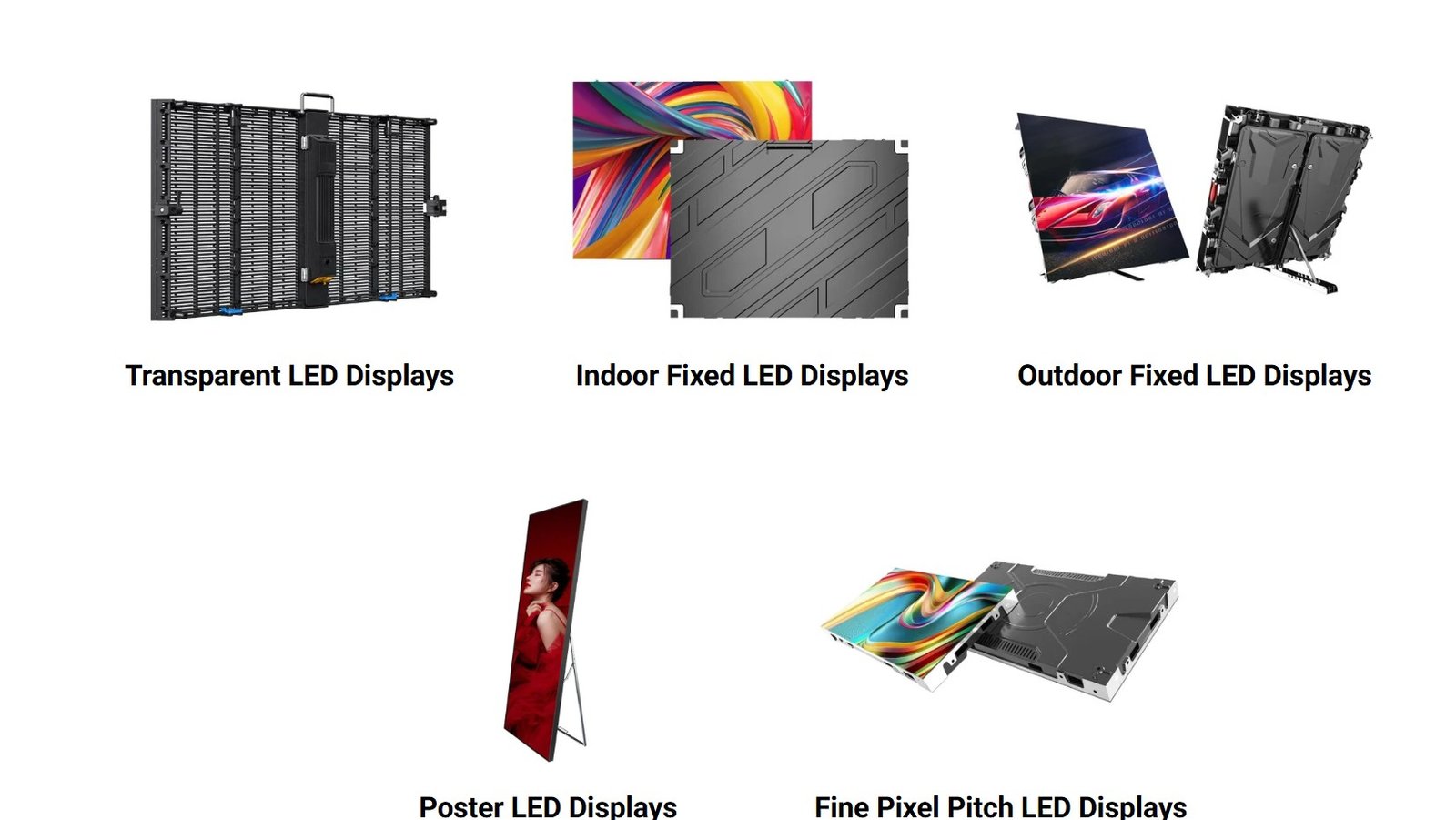
What Is a Fine Pixel Pitch LED Display?
A fine pixel pitch LED display uses closely spaced pixels to produce greater image detail.
These displays can be useful when audiences are relatively close to a large screen.
Common applications may include:
- Corporate boardrooms
- Control rooms
- Broadcast studios
- Design environments
- Premium retail spaces
- Experience centres
- Training rooms
Fine pixel pitch can make text, charts, detailed images, and video appear smoother at shorter viewing distances.
However, the technology may not be necessary for every installation.
For example, an outdoor screen viewed from a long distance may not require extremely fine pixel density because individual pixels become less noticeable as viewing distance increases.
What Is a Transparent LED Display?
A transparent LED display is designed to allow some degree of visibility through the display structure.
This creates possibilities that are different from conventional opaque LED video walls.
Transparent LED technology can be considered for applications such as:
- Glass storefronts
- Retail windows
- Architectural spaces
- Exhibitions
- Showrooms
- Creative installations
The idea is to combine digital content with the physical environment rather than completely replacing the surface behind the display.
For example, a retail store may want to display digital graphics on a glass facade while maintaining visibility into the store.
This illustrates how LED technology is expanding into architectural and creative applications.
What Are Poster LED Displays?
Poster LED displays provide a more compact approach to large-format digital communication.
Instead of assembling multiple cabinets into a large video wall, poster-style displays are designed as standalone units.
They can be useful for:
- Retail stores
- Exhibitions
- Events
- Hotels
- Promotional areas
- Information points
Their smaller footprint can make them suitable for locations where a permanent large video wall would be unnecessary.
The availability of different LED formats allows organizations to choose a display according to the available space and communication requirements.
How Are Indoor LED Displays Used?
Indoor LED displays have applications across many industries.
Corporate Environments
Businesses can use LED displays in meeting rooms, reception areas, training facilities, presentation spaces, and experience centres.
They can show presentations, videos, dashboards, company announcements, and event content.
Retail
Retailers can use large digital screens to communicate product information, promotions, campaigns, and visual storytelling.
The dynamic nature of digital content allows information to be updated without physically replacing printed materials.
Education
Schools, colleges, universities, and training centres can use LED displays for lectures, demonstrations, presentations, assemblies, and events.
Large displays can make content visible to larger groups, particularly in auditoriums and lecture halls.
Hospitality
Hotels, conference centres, and event venues can use indoor LED screens for conferences, stage backgrounds, presentations, schedules, and entertainment.
The ability to create large visual surfaces makes LED technology useful for events where visual presentation is important.
How Are Outdoor LED Displays Used?
Outdoor LED displays are particularly useful when information needs to be visible across large distances.
Advertising
Digital billboards can display changing advertisements, campaigns, videos, and promotional messages.
Sports
Stadiums can use LED screens for live video, scores, player information, statistics, advertisements, and audience engagement.
Entertainment
Concerts and festivals can use large outdoor displays to show performers, visual effects, event information, and live footage.
Public Information
Outdoor displays can communicate announcements, transportation information, public notices, and other time-sensitive messages.
Architectural Applications
Large LED installations can also be integrated into building exteriors and other architectural structures to create digital visual experiences.
What Should You Consider Before Choosing an LED Display?
Selecting an LED display should begin with the application rather than the product specification.
1. Installation Location
First determine whether the display will be installed indoors, outdoors, or in a partially exposed location.
2. Viewing Distance
Identify where the closest and farthest viewers are likely to stand.
This helps determine the appropriate pixel pitch.
3. Ambient Lighting
Consider how much natural and artificial light will reach the screen.
4. Content
Think about whether the display will show text, presentations, videos, advertisements, live broadcasts, graphics, or a combination.
5. Screen Size
Screen size should be determined by the physical space, audience size, viewing distance, and content requirements.
6. Operating Hours
A screen operating for several hours every day may have different power and maintenance considerations from one used only occasionally.
7. Environmental Conditions
Outdoor installations require appropriate consideration of water, dust, heat, humidity, wind, and temperature.
8. Maintenance
Large LED displays should have a practical maintenance strategy. Access to modules and other components can influence servicing time and long-term operating costs.
Common Mistakes When Choosing an LED Display
One common mistake is assuming that the largest screen is automatically the best screen.
A display that is too large for a small room can create an uncomfortable viewing experience. Conversely, a small screen may not provide enough visibility in a large auditorium.
Another mistake is selecting pixel pitch without considering viewing distance.
Choosing an extremely fine pixel pitch may increase costs without providing a noticeable benefit when viewers are positioned far away.
Brightness is another area where buyers can make mistakes. A display needs sufficient brightness for its environment, but maximum brightness is not always necessary.
Environmental protection is also critical. An indoor display should not automatically be assumed to be suitable for outdoor use.
Finally, the initial purchase price should not be the only financial consideration. Installation, electricity consumption, maintenance, spare components, servicing, and expected operating life can all contribute to the overall cost.
How Does Content Affect LED Display Selection?
The type of content being displayed can influence the required specifications.
A screen used primarily for large graphics and advertisements may have different requirements from one used to display spreadsheets or detailed presentations.
Text-heavy content can make pixel structure more noticeable at close distances. High-detail graphics and video can also benefit from appropriate pixel density.
For sports and entertainment, motion handling and refresh characteristics may be important.
For corporate environments, text clarity and comfortable viewing may be higher priorities.
Therefore, it is useful to think about what the audience will actually see, rather than selecting a display based only on technical numbers.
Conclusion
LED displays have transformed the way organizations communicate visually. Their modular structure allows screens to be created in different sizes, while improvements in pixel density, brightness, processing, and display formats have expanded their applications.
The most important distinction is between indoor and outdoor LED displays.
Indoor displays generally operate in controlled environments and often prioritize image detail, viewing comfort, and close-range visibility. Outdoor displays need to provide strong visibility under changing lighting conditions while offering appropriate protection against environmental exposure.
Other technologies, including fine pixel pitch, transparent LED, and poster-style displays, provide additional options for specific applications.
Choosing the right display therefore requires more than looking at screen size or price. Pixel pitch, viewing distance, brightness, environmental conditions, content, operating hours, maintenance, and energy consumption should all be considered.
The right LED display is ultimately the one that matches the environment and the audience’s needs. By understanding the technology before making a selection, organizations can create clearer, more effective, and more reliable digital communication experiences.
Frequently Asked Questions
1. What is the main difference between indoor and outdoor LED displays?
Indoor LED displays are designed for controlled environments and generally focus on image detail, viewing comfort, and shorter viewing distances. Outdoor LED displays are designed to remain visible in daylight and withstand environmental conditions such as rain, dust, heat, and humidity.
2. What does pixel pitch mean?
Pixel pitch is the distance between the centres of neighbouring pixels on an LED display. A smaller pixel pitch generally provides higher pixel density and is more suitable for closer viewing distances.
3. Is a smaller pixel pitch always better?
No. The appropriate pixel pitch depends on viewing distance and content requirements. A very fine pixel pitch may provide little additional benefit when a screen is viewed from a long distance.
4. Why do outdoor LED displays need higher brightness?
Outdoor displays may be exposed to direct sunlight, which can make conventional displays difficult to see. Higher brightness helps the content remain visible under strong ambient light.
5. Can an indoor LED display be used outdoors?
An indoor LED display should not be used outdoors unless it has been specifically designed and rated for the environmental conditions of the installation. Outdoor environments can expose displays to water, dust, sunlight, humidity, and temperature changes.
6. What factors should be considered before buying an LED display?
Important factors include installation location, viewing distance, brightness, pixel pitch, screen size, content type, operating hours, environmental conditions, maintenance requirements, energy consumption, and budget.
7. What is a fine pixel pitch LED display?
A fine pixel pitch LED display has closely spaced pixels, allowing it to produce detailed images at relatively short viewing distances. It can be useful in environments such as boardrooms, control rooms, studios, premium retail spaces, and experience centres.
8. What are transparent LED displays used for?
Transparent LED displays allow digital content to be shown while maintaining some visibility through the display. They can be useful for glass storefronts, exhibitions, architectural installations, showrooms, and creative digital environments.
Read Also: Smarter Visuals with All-in-One LED Display Solutions





Leave a Reply