
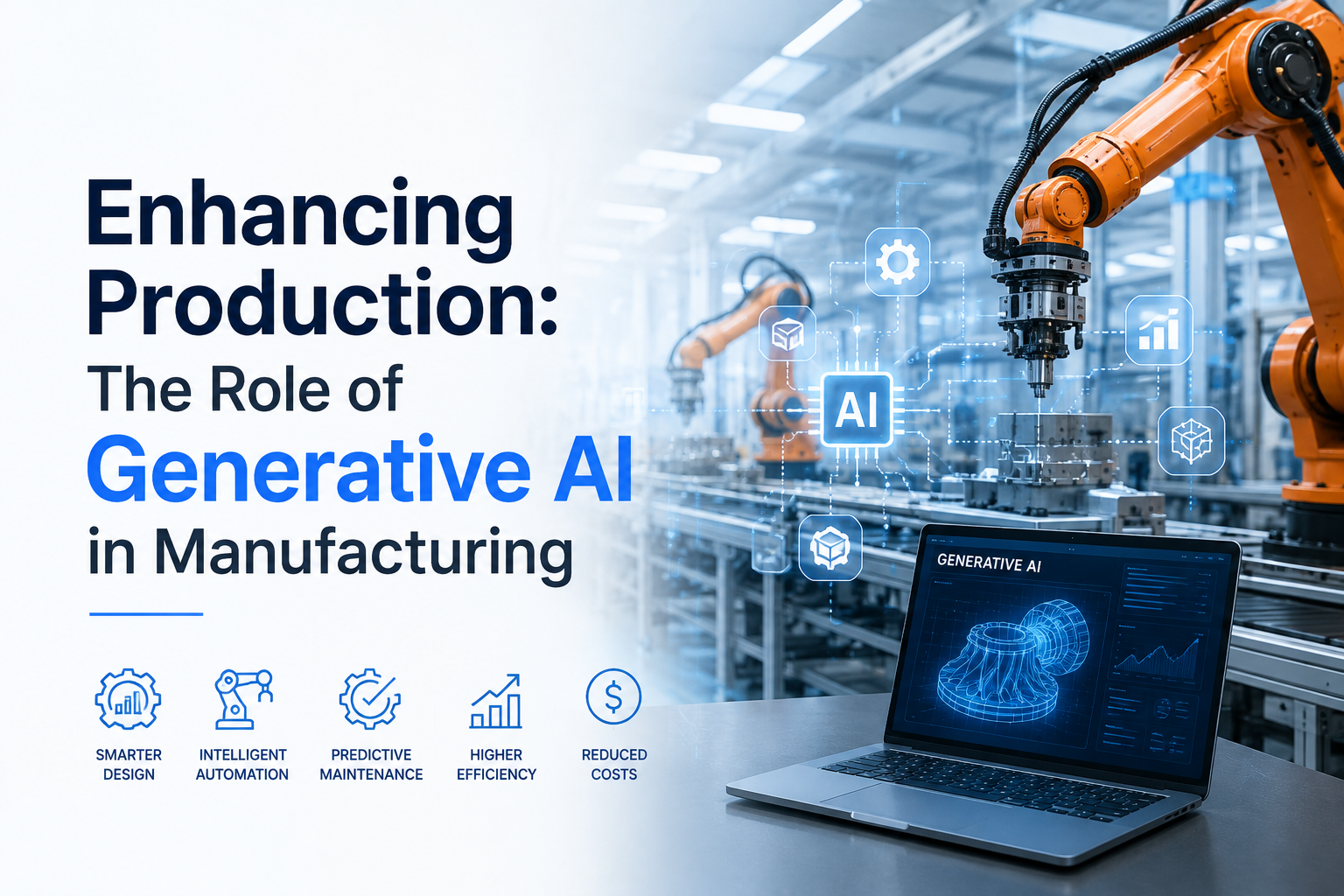
Manufacturing has always evolved alongside technology. From automation and robotics to connected machines and data-driven systems, every major innovation has helped manufacturers improve productivity, reduce waste, and respond more effectively to changing market demands. Generative AI is now becoming another important technology with the potential to reshape how manufacturers design products, manage operations, support employees, and improve production processes.
Unlike traditional automation, generative AI can create and analyze content based on the information it receives. It can generate design concepts, summarize technical documents, assist with troubleshooting, support quality processes, and help employees access useful information more quickly. When manufacturers apply the technology to the right use cases, generative AI can become a practical tool for improving efficiency and supporting smarter production decisions.
Understanding Generative AI in Manufacturing
Generative AI refers to artificial intelligence systems that can create new outputs based on patterns and information from the data they process. These outputs may include text, images, code, designs, reports, technical documentation, or recommendations. In a manufacturing environment, this capability can support a wide range of activities across engineering, production, maintenance, supply chain management, and customer service.
The technology does not replace every manufacturing system already in place. Instead, it can work alongside existing software, operational data, machine information, and human expertise. Manufacturers can use generative AI to make complex information easier to access and to support employees who need faster answers, better insights, or assistance with repetitive knowledge-based tasks.
Improving Product Design and Engineering
Product design is one of the areas where generative AI can create significant value. Engineers often need to consider multiple requirements, including performance, materials, cost, manufacturability, and product specifications. Generative AI can support the design process by helping teams explore different concepts and analyze potential options more efficiently.
For example, engineering teams can use AI-powered tools to generate design ideas based on specific requirements or summarize large amounts of technical information. This can reduce the time spent on early-stage research and allow engineers to focus more on evaluating options and making informed decisions. The technology can support creativity and experimentation without removing the need for human engineering expertise.
Streamlining Production Planning
Production planning requires manufacturers to coordinate people, machines, materials, schedules, and operational requirements. Small changes in demand, supply availability, or equipment performance can affect the entire production process. Generative AI can help teams process large amounts of operational information and present it in a more understandable format.
Manufacturers can also use AI to support planning by generating reports, summarizing production data, and helping managers identify important trends. Instead of manually reviewing information from multiple systems, employees can use intelligent tools to access relevant insights more quickly. This can support faster decision-making and help organizations respond more effectively to changing production conditions.
Supporting Predictive Maintenance
Unexpected equipment failures can create expensive delays and disrupt production schedules. Traditional predictive maintenance systems already use machine data to identify potential issues, while generative AI can add another layer of support by making technical information easier to interpret.
For example, maintenance teams can use generative AI to summarize equipment records, analyze maintenance documentation, and provide relevant troubleshooting information. An AI assistant connected to approved technical data could help technicians quickly locate maintenance procedures or identify similar issues that occurred in the past. This can reduce the time spent searching through complex documentation and support faster problem resolution.
Enhancing Quality Control Processes
Quality control plays a critical role in manufacturing because even small defects can lead to waste, additional costs, customer complaints, or safety concerns. Generative AI can support quality teams by helping them analyze reports, summarize inspection findings, and identify recurring patterns in quality-related information.
When combined with technologies such as computer vision and machine learning, generative AI can also help employees understand and communicate quality issues more effectively. Instead of manually reviewing large amounts of inspection data, teams can use AI-generated summaries and insights to investigate potential problems. Human quality professionals can then use their expertise to evaluate the findings and determine the appropriate action.
Improving Access to Manufacturing Knowledge
Manufacturing organizations often have large amounts of valuable information spread across manuals, maintenance records, engineering documents, training materials, and internal systems. Employees may spend considerable time searching for the right information, especially when they need to solve a technical problem quickly.
Generative AI can help create intelligent knowledge assistants that allow employees to ask questions in natural language. Instead of searching through multiple documents, a technician or engineer may be able to request relevant information and receive an answer based on approved internal sources. This can make organizational knowledge more accessible while helping experienced employees share valuable expertise across the business.
Strengthening Supply Chain Decision-Making
Supply chain disruptions can directly affect production schedules, inventory levels, and customer commitments. Manufacturers need to process information from suppliers, logistics systems, inventory platforms, and market conditions to make effective decisions.
Generative AI can support supply chain teams by summarizing complex information, generating reports, and helping employees identify potential risks. For example, an AI system could assist managers in reviewing supplier communications or understanding how changes in material availability may affect production plans. While human decision-makers remain responsible for important business choices, AI can reduce the time required to collect and organize relevant information.
Supporting the Manufacturing Workforce
There is often concern that AI will simply replace employees. However, one of the most practical uses of generative AI in manufacturing is supporting workers rather than replacing them. Employees can use AI tools to access technical knowledge, create documentation, summarize reports, and receive assistance with routine information-related tasks.
This support can be particularly useful for training and knowledge transfer. Experienced employees often possess valuable operational knowledge that can be difficult to document and share. Generative AI can help organize this information and make it easier for newer employees to access relevant guidance. The technology can therefore support workforce development while allowing employees to focus on tasks that require hands-on skills, judgment, and experience.
Integrating Generative AI With Existing Systems
The value of generative AI increases when it connects with the systems manufacturers already use. Manufacturing organizations often rely on enterprise resource planning platforms, manufacturing execution systems, product lifecycle management software, quality management tools, and other operational technologies.
Integration allows AI applications to access relevant information and provide support within existing workflows. However, businesses need to carefully manage data access, permissions, and system security. AI development companies can help manufacturers design solutions that connect with appropriate systems while maintaining control over sensitive operational and business information.
Addressing Data Security and Reliability
Manufacturing companies often manage confidential information, including product designs, engineering documents, customer details, and proprietary production processes. Before implementing generative AI, organizations need to understand how their information will be processed, stored, and protected.
Reliability is equally important. Generative AI can produce incorrect or incomplete responses, which means manufacturers should establish processes for validating important outputs. Human oversight, access controls, reliable data sources, and regular monitoring can help organizations use the technology more responsibly. Businesses should treat generative AI as a decision-support tool rather than assuming that every output is automatically correct.
Starting With Practical Use Cases
Manufacturers do not need to transform every process at once. Starting with a focused use case can help organizations understand how generative AI performs within their specific environment. A company might begin with an internal knowledge assistant, automated technical documentation, maintenance support, or production reporting.
A smaller implementation allows teams to evaluate performance, collect employee feedback, identify security requirements, and measure business outcomes. If the project delivers meaningful value, the organization can expand the technology into other areas. This approach can reduce risk and create a more practical path toward broader AI adoption.
Measuring the Impact on Production
Manufacturers should measure the success of generative AI based on practical business results. Depending on the use case, organizations may evaluate factors such as reduced time spent searching for information, faster report generation, improved maintenance response, increased employee productivity, or reduced production delays.
Clear performance measures help businesses determine whether the technology is creating value. They also provide useful information for improving the system after implementation. A successful AI initiative should continue to evolve based on user feedback, operational changes, and new business requirements.
The Future of Generative AI in Manufacturing
Generative AI is likely to become increasingly integrated with other manufacturing technologies. As organizations improve their data infrastructure and connect more systems, AI may play a larger role in supporting engineering, operations, maintenance, supply chain management, and workforce productivity.
The greatest opportunities will likely come from combining AI capabilities with human expertise and existing operational technologies. Manufacturers that take a practical approach can identify high-value use cases, test solutions carefully, and expand successful applications over time. Rather than treating generative AI as a standalone technology, businesses can use it as part of a broader strategy for improving production and operational performance.
Conclusion
Generative AI has the potential to support significant improvements across the manufacturing industry. From product design and production planning to maintenance, quality control, supply chain management, and workforce support, the technology can help manufacturers process information faster and improve everyday decision-making.
Successful adoption requires a clear strategy, reliable data, secure integration, and appropriate human oversight. By starting with practical use cases and measuring real business outcomes, manufacturers can move beyond experimentation and build AI solutions that create lasting value. As the technology continues to evolve, generative AI may become an increasingly important part of smarter, more efficient, and more connected manufacturing operations.





Leave a Reply