
For many SaaS teams, SOC 2 compliance is often seen as a separate initiative—something handled by security or compliance teams after the product is built. In reality, the most efficient path to compliance is when it is embedded directly into software development practices.
Modern development teams already follow structured workflows. With a few intentional adjustments, these workflows can naturally align with SOC 2 compliance requirements without slowing down engineering velocity.
Shift Left: Making Compliance a Development Responsibility
A practical way to approach SOC 2 is by shifting compliance “left” into the development lifecycle. Instead of retrofitting controls later, teams can incorporate compliance thinking during design, development, and deployment. This reduces rework and ensures that compliance becomes part of everyday engineering decisions rather than a last-minute effort.
1. Build Access Control into Development Workflows
Access management is a core part of SOC 2. Development teams typically use tools like GitHub, GitLab, or Bitbucket to manage repositories. By enforcing role-based access, limiting admin privileges, and regularly reviewing access rights, teams can turn existing practices into audit-ready controls. The key is documentation and periodic validation.
2. Strengthen Change Management Through PR Processes
Most teams already use pull requests (PRs) for code changes. SOC 2 requires formal change management, but this doesn’t mean adding new layers of bureaucracy. Instead, teams can enforce mandatory code reviews, require approvals before merging, and maintain logs of all changes. These existing PR workflows become strong evidence for compliance when consistently followed.
3. Enhance Logging and Monitoring Early
Application and infrastructure logs are critical for SOC 2. Development teams can integrate logging as a default practice—capturing user activity, system changes, and error events. Pairing this with monitoring tools ensures that incidents can be detected and addressed quickly. This not only supports compliance but also improves system reliability.
4. Integrate Security into the Development Lifecycle
Secure coding practices are essential. This includes using dependency scanning tools, static code analysis, and vulnerability checks during development. Instead of treating security as a final step, embedding it into CI/CD pipelines ensures continuous validation. Over time, this reduces risk while aligning with compliance expectations.
5. Formalize Incident Response Practices
Incidents happen in every organization. What matters for SOC 2 is how they are handled. Development teams should document incident response procedures, define escalation paths, and maintain records of incidents and resolutions. Even simple practices like maintaining an incident log can go a long way.
6. Align Documentation with Real Workflows
One of the biggest gaps in SOC 2 readiness is not lack of controls, but lack of documentation. Development teams often perform the right actions but fail to formalize them. Converting existing workflows into policies and standard operating procedures ensures that practices are both repeatable and auditable.
7. Use Automation Where It Matters
Automation can help collect evidence such as access logs, configuration states, and change history. However, SOC 2 is not purely about automation. It is about demonstrating that processes are consistently followed. A balanced approach—combining automation with human oversight—is the most effective.
8. Map Development Activities to Control Objectives
A useful step for teams is to map everyday development activities directly to SOC 2 control requirements. For example, access provisioning maps to logical access controls, PR approvals map to change management, and logging maps to system monitoring. This mapping exercise helps teams understand that much of the compliance effort is already in place, requiring only refinement and consistency.
9. Maintain Evidence Continuously, Not Just Before Audits
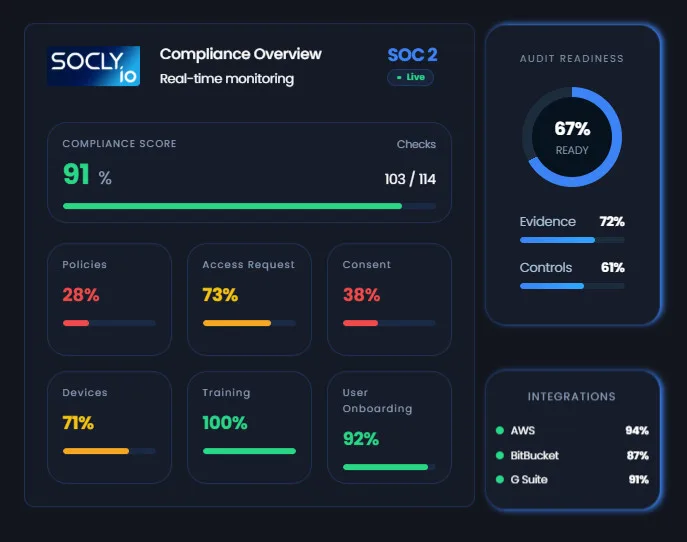
One common challenge is scrambling to collect evidence right before an audit. Instead, teams should adopt a continuous evidence approach—capturing logs, approvals, and configurations as part of regular operations. This reduces stress during audits and ensures accuracy. Platforms like SOCLY.io are often used by teams to streamline this process by organizing evidence and aligning it with controls, without disrupting engineering workflows.
10. Foster Collaboration Between Engineering and Compliance Teams
SOC 2 success depends on collaboration. Engineering teams understand systems and workflows, while compliance teams understand control requirements. Bringing these perspectives together ensures that controls are both practical and aligned with real-world operations. Regular check-ins, shared dashboards, and clear ownership of controls can significantly improve outcomes.
By aligning development practices with SOC 2 compliance, organizations can avoid last-minute compliance efforts and instead build a strong foundation from day one. The goal is not to change how teams work, but to structure and validate what they are already doing.
In the long run, this approach not only simplifies audits but also leads to more secure, reliable, and scalable software systems. More importantly, it creates a culture where compliance is not seen as a burden, but as a natural extension of good engineering practices.




Leave a Reply