
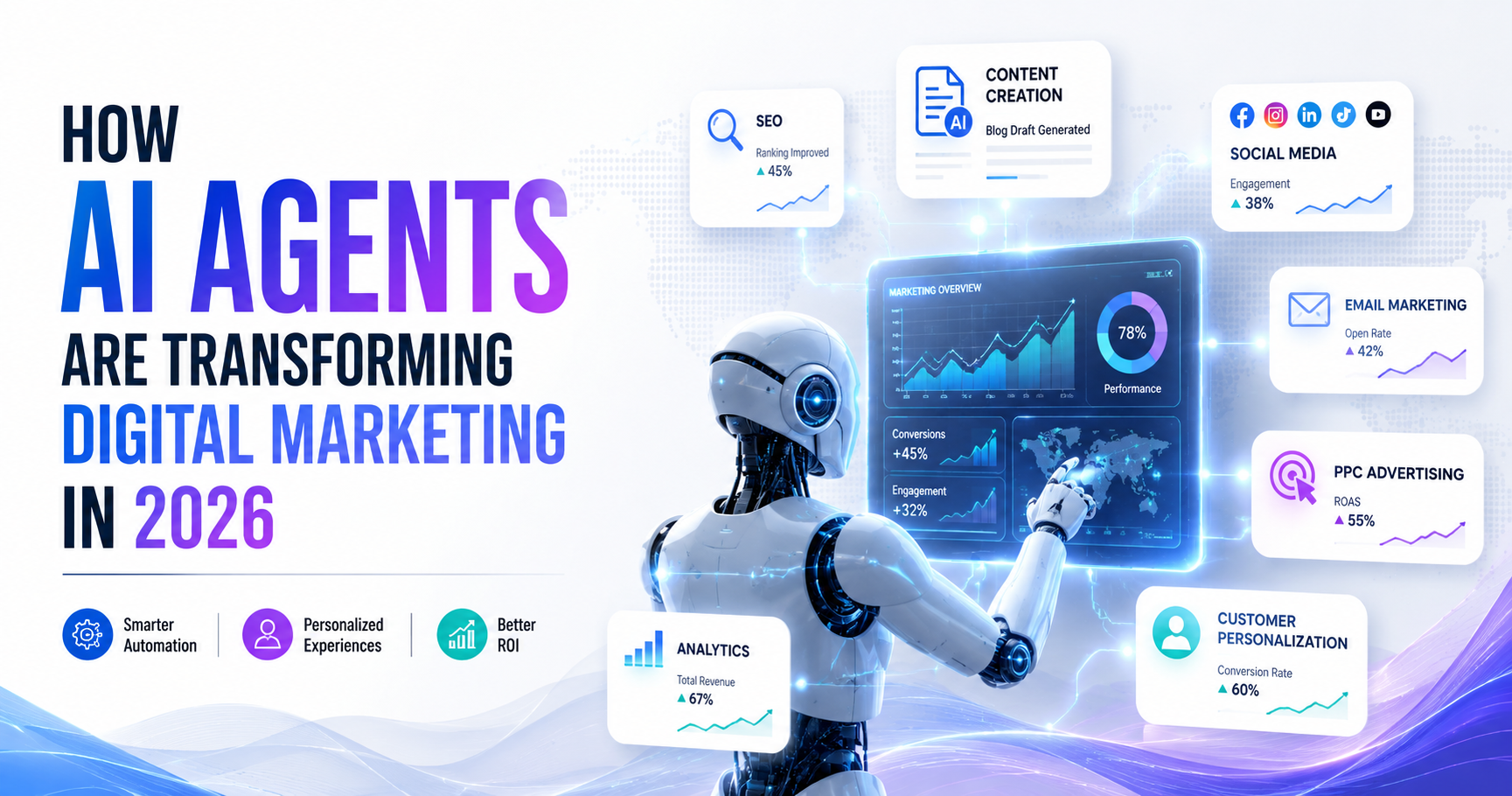
Artificial intelligence has already reshaped digital marketing through automation, predictive analytics, and content generation. However, 2026 marks the rise of something even more impactful: AI agents. Unlike traditional AI tools that respond to individual prompts, AI agents can plan, execute, monitor, and optimize entire marketing workflows with minimal human intervention.
From managing paid advertising campaigns to personalizing customer experiences in real time, AI agents are becoming valuable digital teammates rather than simple assistants. Businesses that embrace this technology are improving efficiency, reducing costs, and making faster, data-driven decisions.
This article explores how AI agents are transforming digital marketing, where they deliver the greatest value, and how marketers can use them responsibly.
What Are AI Agents?
AI agents are intelligent software systems capable of performing multi-step tasks independently. Instead of answering one question at a time, they can understand goals, create execution plans, use various digital tools, analyze results, and continuously improve their performance.
For example, a traditional AI chatbot may generate an email subject line. An AI marketing agent can:
- Analyze customer segments
- Generate multiple email variations
- Schedule campaigns
- Monitor open and click-through rates
- Optimize future emails based on performance
- Prepare detailed reports for the marketing team
This ability to work across multiple stages of a workflow makes AI agents significantly more powerful than standard AI assistants.
Why AI Agents Matter in Digital Marketing
Modern marketing involves countless repetitive and data-heavy tasks. Campaign management, SEO, social media scheduling, customer support, analytics, and content optimization all require continuous attention.
AI agents help marketers by:
- Automating repetitive workflows
- Processing large datasets instantly
- Delivering personalized customer experiences
- Making recommendations based on live performance
- Allowing teams to focus on strategy and creativity
Instead of replacing marketers, AI agents amplify their productivity.
AI Agents in Content Marketing
Content remains one of the most important marketing channels, but producing high-quality content consistently can be challenging.
AI agents simplify the entire content lifecycle by:
- Discovering trending topics
- Performing keyword research
- Creating detailed content outlines
- Suggesting internal linking opportunities
- Optimizing articles for search intent
- Tracking rankings after publication
- Recommending content updates based on performance
Rather than replacing writers, AI agents handle research and optimization while human experts focus on originality, storytelling, and brand voice.
Smarter SEO With AI Agents
Search engine optimization has become increasingly complex as search engines evolve and AI-powered search experiences grow.
AI agents can continuously monitor SEO performance by:
- Detecting ranking changes
- Identifying technical SEO issues
- Finding new keyword opportunities
- Analyzing competitors
- Recommending content improvements
- Tracking backlinks
- Monitoring Core Web Vitals
Because these systems operate around the clock, businesses can react to ranking fluctuations much faster than with manual processes.
Personalized Customer Experiences
Consumers now expect personalized interactions across every digital channel.
AI agents analyze user behavior, including:
- Browsing history
- Purchase patterns
- Search behavior
- Device preferences
- Engagement history
Using this information, AI agents can automatically recommend products, personalize landing pages, adjust email messaging, and deliver more relevant offers.
This level of personalization increases customer satisfaction while improving conversion rates.
AI Agents in Paid Advertising
Managing paid advertising campaigns often requires continuous monitoring and optimization.
AI agents assist marketers by:
- Adjusting bids automatically
- Testing multiple ad creatives
- Allocating budgets across campaigns
- Identifying underperforming keywords
- Predicting campaign performance
- Detecting unusual spending patterns
Instead of manually reviewing campaigns every few hours, marketers receive actionable insights and automated optimizations in real time.
Social Media Management at Scale
Maintaining an active social media presence requires constant planning and engagement.
AI agents can help by:
- Creating content calendars
- Suggesting trending topics
- Scheduling posts across platforms
- Responding to common customer inquiries
- Monitoring brand mentions
- Identifying viral conversations
- Measuring engagement performance
Marketing teams can therefore spend less time on repetitive publishing tasks and more time building authentic communities.
Better Marketing Analytics
One of the greatest advantages of AI agents is their ability to transform raw data into meaningful insights.
Instead of reviewing dozens of dashboards, marketers receive concise reports explaining:
- Which campaigns performed best
- Why conversions increased or decreased
- Which customer segments generated the highest ROI
- What actions should be taken next
This reduces decision-making time while improving marketing performance.
Customer Support Powered by AI Agents
Customer experience plays a major role in digital marketing success.
Modern AI agents support customer service by:
- Answering frequently asked questions
- Qualifying leads
- Booking appointments
- Providing product recommendations
- Escalating complex issues to human agents
Available 24/7, AI agents improve response times while reducing operational costs.
Challenges Businesses Should Consider
Despite their advantages, AI agents should be implemented carefully.
Organizations should pay attention to:
Data Privacy
AI systems often process customer information. Businesses must comply with privacy regulations and handle data responsibly.
Human Oversight
AI-generated recommendations should always be reviewed by experienced marketers before major strategic decisions are made.
Brand Consistency
Without proper guidelines, AI-generated content may lose the brand’s unique voice. Human editing remains essential.
Transparency
Customers increasingly value transparency regarding AI-generated interactions. Businesses should clearly communicate when AI is involved.
Best Practices for Using AI Agents
Companies adopting AI agents should follow several best practices:
- Define clear business objectives before implementation.
- Combine AI automation with human creativity.
- Continuously monitor AI-generated outputs.
- Train marketing teams to work alongside AI systems.
- Measure ROI using meaningful performance metrics.
- Keep customer trust and data privacy as top priorities.
The most successful organizations treat AI agents as collaborative partners rather than complete replacements for human expertise.
The Future of AI Agents in Digital Marketing
As AI technology continues to evolve, marketing agents will become increasingly autonomous and interconnected. Future systems will coordinate across SEO, advertising, email marketing, CRM platforms, analytics, and customer support simultaneously.
Instead of managing isolated marketing tools, businesses will oversee intelligent ecosystems capable of making informed decisions across multiple channels.
However, the competitive advantage will not come from using AI alone. It will come from combining AI efficiency with human creativity, strategic thinking, and genuine customer understanding.
Conclusion
AI agents are redefining digital marketing by automating complex workflows, improving personalization, enhancing campaign performance, and delivering actionable insights faster than ever before. They enable marketers to spend less time on repetitive tasks and more time on innovation and relationship building.
Businesses that adopt AI agents thoughtfully—while maintaining human oversight and ethical standards—will be better positioned to compete in an increasingly data-driven digital landscape. As AI continues to mature, the collaboration between skilled marketers and intelligent agents will shape the next generation of successful marketing strategies.





Leave a Reply