
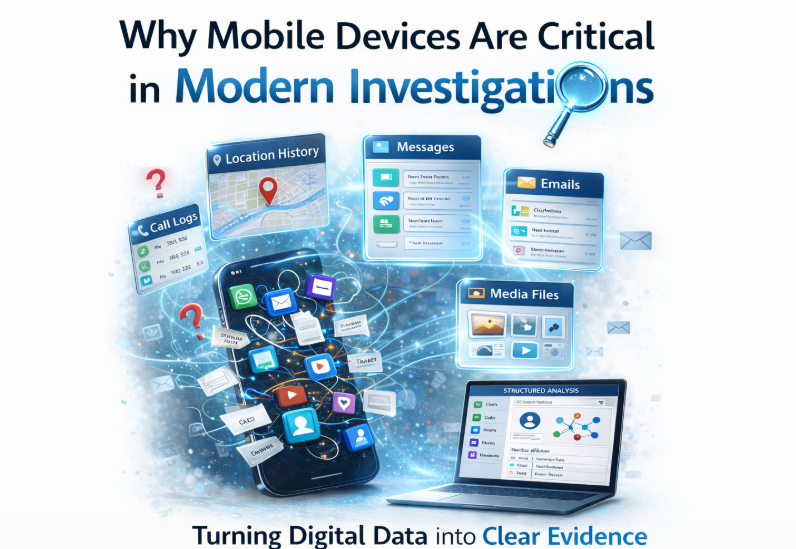
Mobile devices are no longer just communication tools; they have become the primary source of digital evidence in modern investigations. Every interaction, from a simple message to a location ping, creates a trace.
The challenge today is not finding evidence. It is understanding large volumes of scattered data and turning it into a clear, reliable story.
In fact, many investigations today are not limited by a lack of information they are slowed down by information overload. Investigators are often surrounded by thousands of data points, but without clarity, those data points remain meaningless.
The real shift in modern investigations is simple:
- It is no longer about collecting more data.
- It is about making sense of the data that already exists.
Investigations Now Begin with Mobile Devices
The starting point of investigations has shifted dramatically. Where desktops once dominated, smartphones now lead.
People rely on mobile devices for:
- Daily communication across apps
- Email exchanges and document sharing
- Capturing photos and videos
- Navigation and location tracking
- Financial transactions and authentication
A mobile device acts like a real-time activity recorder. For investigators, this means access to a detailed timeline of actions, decisions, and movements.
Every tap, swipe, and interaction leaves behind a footprint. Even small activities—like opening an app or connecting to a network can provide valuable insights. When combined, these actions form a behavioral blueprint, helping investigators understand not just what happened but also the sequence and intent behind it.
This is why mobile devices are often the first and most critical source of evidence in modern cases.
The Real Problem: Data Exists Everywhere
While mobile devices provide valuable evidence, they also introduce complexity.
Investigators often face:
- Data distributed across multiple applications
- Different formats generated by different tools
- Large volumes of information to review
- Time-sensitive analysis requirements
It is similar to having multiple reports from different departments without a unified view. Each piece is useful, but without connection, the full picture remains unclear.
This fragmentation creates a major bottleneck. Instead of focusing on analysis, investigators spend significant time:
- Sorting data
- Converting formats
- Searching for relevant information
As a result, investigations become slower and less efficient. More importantly, critical evidence can remain hidden within the noise.
What Kind of Evidence Exists in Mobile Devices
Mobile devices contain diverse types of evidence that contribute to a complete investigation:
- Messages from SMS and chat platforms
- Emails and their attachments
- Multimedia files such as photos and videos
- Call records and contact details
- Location and movement history
- App usage patterns and timestamps
Each data type adds a layer of context. When analyzed together, they provide insights into actions, intent, and the sequence of events.
For example:
- A message may indicate communication
- A location record may confirm presence
- A timestamp may establish timing
- A file may provide supporting proof
When these elements are connected, they transform isolated data points into a clear and structured narrative.
Why Traditional Methods Fall Short
Traditional forensic approaches often depend on multiple tools and manual processes.
A typical workflow might involve:
- Extracting mobile data using one solution
- Reviewing emails separately
- Manually correlating information across datasets
This creates several challenges:
- Delays due to manual effort
- Risk of overlooking critical evidence
- Difficulty in correlating data across sources
- Increased complexity in building timelines
It is like reading different chapters of a book in random order. The information is there, but the story is missing.
Additionally, manual processes introduce inconsistencies. Different investigators may interpret the same data differently, leading to variations in conclusions. This lack of uniformity can weaken the reliability of findings.
In fast-paced investigations, this approach is no longer sustainable.
Making Sense of Complex Mobile Data
Mobile forensic data is inherently complex due to its volume and diversity. Without a structured system, it becomes difficult to interpret.
To manage this complexity, investigators need an approach that allows them to:
- Prioritize relevant information
- Minimize manual intervention
- Accelerate the investigation process
- Maintain consistency in analysis
In real-world scenarios, data often originates from multiple forensic tools and formats. This includes widely used sources such as MSAB, Oxygen, and UFED, each contributing valuable but separate datasets.
Handling these independently increases effort and reduces efficiency. Investigators may spend hours navigating different formats instead of focusing on insights.
A unified approach changes this completely. When data is brought together and organized:
- Patterns become visible
- Relationships become clearer
- Timelines become easier to build
This shift from scattered data to structured analysis is what transforms complexity into clarity and confidence.
A Smarter Way to Handle Investigations
Modern investigations require more than data extraction—they require data integration and intelligent analysis.
When data is brought together effectively, investigators can:
- Identify communication patterns across platforms
- Correlate mobile activity with email evidence
- Construct accurate timelines
- Detect anomalies and hidden connections
Solutions like MailXaminer support this approach by enabling structured analysis of email data alongside mobile evidence. This allows investigators to work in a unified environment instead of switching between multiple tools.
By simplifying the analysis process, investigators can:
- Focus on insights instead of data management
- Reduce investigation time
- Improve accuracy and reliability
This is where modern investigations gain their real strength—not from the amount of data collected, but from how effectively that data is analyzed.
From Data to Actionable Evidence
The difference between raw data and actionable evidence lies in clarity.
Without structure:
- Data remains scattered
- Connections are difficult to identify
- Analysis becomes time-consuming
- Important clues may be overlooked
With structure:
- Information is organized
- Relationships become visible
- Patterns are easier to detect
- Decisions can be made with confidence
This transformation is critical in ensuring that investigations are both efficient and accurate.
When data is clear and connected, investigators can build stronger cases, present findings more effectively, and ensure that conclusions are backed by solid evidence.
Conclusion
Mobile devices have become central to modern investigations because they capture a wide range of human activity. However, the true value of this data lies in how effectively it is analyzed.
Traditional methods often fall short due to fragmentation and manual effort. A unified and structured approach enables investigators to connect mobile and email data, uncover meaningful insights, and build strong, evidence-based conclusions.
In today’s digital landscape, success in investigations depends not just on access to data, but on the ability to transform that data into clarity, confidence, and actionable truth




Leave a Reply