
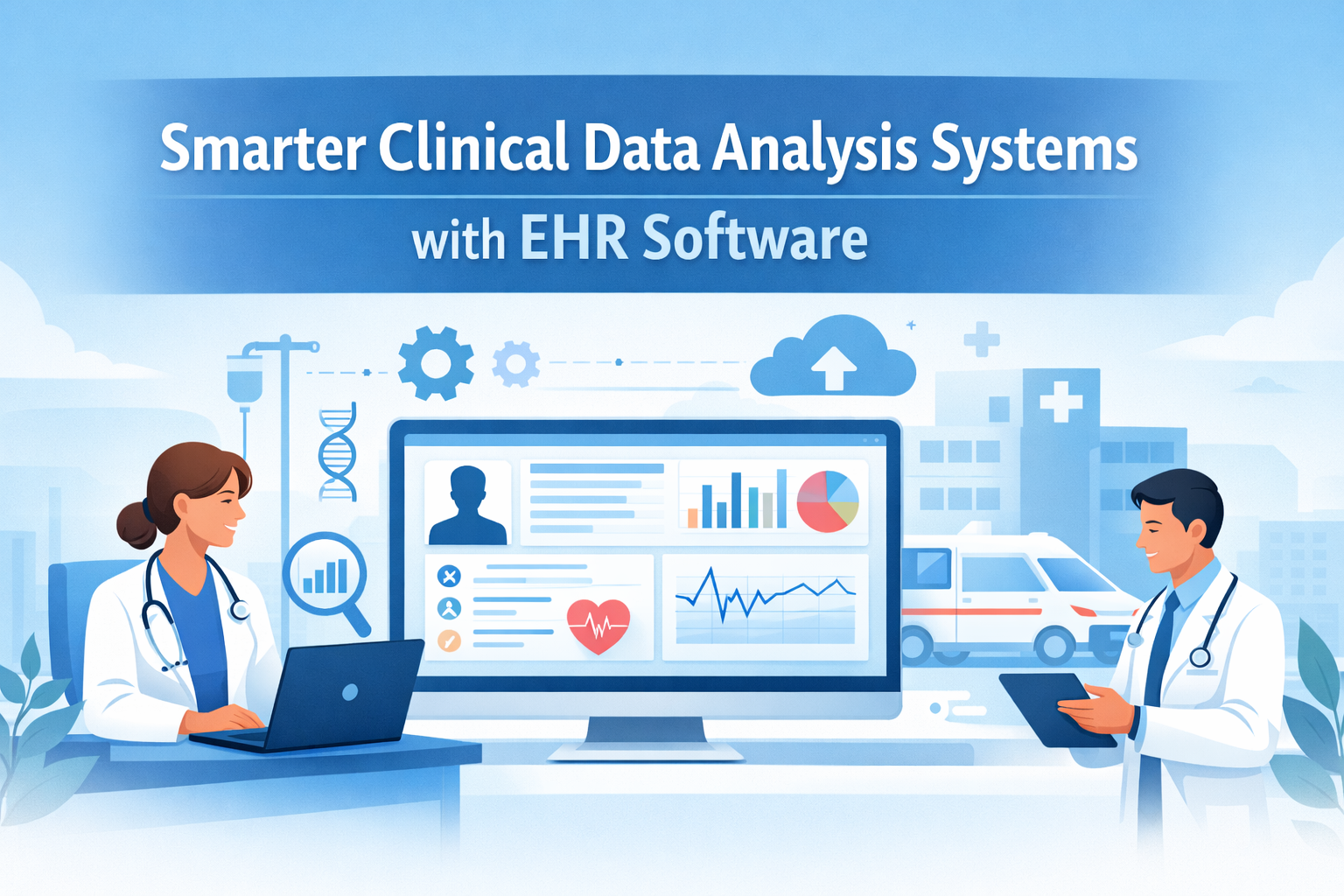
Electronic Health Records and Introduction to EHR Software
Patient information management is a critical aspect of the healthcare environment in the contemporary digital world, where it is necessary to enhance outcomes and operational efficiency. The EHR Software has emerged as a foundation for developing more intelligent clinical data analysis systems through the provision of real-time access to ordered Electronic Health Records. Healthcare providers can use secure Electronic Health Records Software to simplify workflow, minimize mistakes, and use analytics to make informed decisions. Learning what EHR software is and applying the Benefits of EHR enables the organization to enhance patient care and improve the accuracy of reporting, and promote data-driven healthcare systems.
What Is EHR Software for Clinical Data Analysis
What Is EHR Software and Electronic Health Record System Software
EHR Software is an electronic product that captures, handles, and stores patient health data in various care environments. In contrast to the old ones, electronic health record system software unites the information about patients into a single Electronic Health Record, which allows healthcare providers to conduct a thorough clinical data analysis effectively.
The Electronic Health Records Software records patient demographics, lab results, diagnostic reports, and treatment histories, which facilitates the possibility to:
- Always make sure that the clinicians have the correct information about patients.
- Limit the mistakes resulting in manual data entry.
- Back up enhanced clinical analytics using unstructured datasets.
Such features represent the Advantages of EHR in the development of smarter healthcare analytics systems.
EHR Software Use in Clinical Data Analysis
The Role of EHR Software in Improving Data Accuracy
Among the major opportunities of EHR Software, one can identify the possibility to enhance the quality of clinical data. Electronic Health Records Software makes Electronic Health Records complete, reliable, and consistent by automating the documentation process and standardizing the data entry process. This enables healthcare institutions to make analysis of patient data with confidence.
The Advantages of EHR in terms of the accuracy of the data are:
- Minimizing errors in documentation, which results in quality patient care.
- Consistency in the terminology of clinical activity, inter-departmental consistency.
- Longitudinal record keeping, which enables clinicians to monitor the health patterns of patients over time.
Electronic Health Records Software: Real-Time Analytics
Contemporary EHR Software offers real-time analytics, which allow healthcare providers to assess patient data in real-time. With the Electronic Health Records Software, organizations are able to determine trends, predict risks, and make informed treatment decisions.
The advantages of EHR use in real-time analytics are:
- Quick decision-making to achieve better patient outcomes.
- Improved patient safety through for seeing of risks.
- Earlier detection in diseases results in superior preventive methods.
EMR Software Development
Development of EMR Software to EHR Software
The previous EMR software development was based on the digitalization of records in single healthcare institutions. Modern EHR Software is broadened to include other departments, laboratories, and external systems. Further ehr software development facilitates safe sharing of data, interoperability, and analytics-ready format, thereby making smarter clinical decisions with Electronic Health Records Software.
Clinical Intelligence Software
Predictive analytics, AI-driven insights, and real-time reporting are built into EHR Software by continually developing ehr software. Electronic Health Records can be studied to produce trends that allow healthcare organizations to develop optimal treatment patterns, optimize treatment, and enhance patient outcomes. These advances underscore the Advantages of EHR in developing smart healthcare.
The Advantages of EHR Software in Healthcare Data
The Most Important Benefits of EHR Software in Clinical Analytics
The advantages of EHR go beyond simple documentation. EHR Software enables health professionals to gain operational and clinical outcomes out of Electronic Health Records, enhancing operational and clinical efficiency.
Key advantages include:
- Better clinical decision-making, fewer mistakes, and fewer incorrect diagnoses.
- Shared patient records among the departments have enhanced coordination of care.
- Less operational wastefulness, resource, and time savings.
- Better population health understanding, which enables management of community health efforts to be done effectively.
Health Records Cooperation: Electronic Health Records Software
Electronic Health Records Software enhances cooperation by allowing several teams to use common Electronic Health Records. This guarantees a smooth transfer of care and improves the general Benefits of EHR in a multi-disciplinary healthcare setting.
EHR Software Data Safety and Regulatory Conformity
Data Privacy of Electronic Health Records
Any healthcare analytics system depends heavily on data security. Electronic Health Records Software offers encryption, authentication, and role-based access control, which helps to ensure patient information is safe and confidential with the help of EHR Software.
Security-related Benefits of EHR include:
- Preventing sensitive patient information from unauthorized access.
- Having accountability and audit trails of all records.
- Adherence to the regulatory standards, easing audits and inspections.
Regulatory Compliance Using Electronic Health Records Software
EHR Software eases compliance with the healthcare regulations. Electronic Health Records enable healthcare organizations to produce audit-compliant reports in an efficient manner and stay in tandem with the global/national healthcare standards.
- The audits can be completed in a shorter time and are more dependable as all the clinical data entries are tracked.
- Nonconformities are raised and rectified to ensure patient safety and compliance with the regulations.
- Standardized reporting enhances transparency, which enforces organizational trust.
Interoperability and Data Integration
Automatic Data Interchange with EHR Software
EHR Software facilitates interoperability, which has enabled Electronic Health Records Software to interface with labs, radiology, pharmacy, and external healthcare providers. This guarantees Electronic Health Records are standardized, whole, and analytics-ready.
- The data on patients is integrated across the different departments, which allows a full analysis.
- The clinical workflows are shortened, eliminating delays and redundancies.
- The accuracy of the data is preserved, and it leads to high-quality clinical observations.
Clinical System Integration Through EHR Software Development
Current ehr software development incorporates various clinical systems in Electronic Health Records Software, which allows full clinical intelligence and enhanced patient outcomes.
EHR Software India and the Best EHR Software
Growth of EHR Software India
Ehr software india has expanded rapidly because of low-cost solutions adhering to international standards. EHR Software developed in India has scalable Electronic Health Records Software which assists in analyzing clinical data efficiently across various healthcare organizations.
Best EHR Software to Use in Clinical Data Analysis
Selecting the best EHR software guarantees access to advanced analytics, predictive tools, and interoperability, improving the Benefits of EHR in both clinical and administrative workflows.
- Predictive analytics is used to predict patient risks.
- Better decision-making is provided through visual dashboards.
- Scalable platforms are flexible to increasing clinical and operational requirements.
Clinical Data Analysis: Patient-Centric
EHR Software enhances interaction between patients and healthcare providers through secure access to Electronic Health Records. Electronic Health Records Software enables collaboration as patients access test results, treatment plans, and histories.
- Patients can access their health information, enhancing trust.
- Patient compliance with treatment is enhanced when patients are informed.
- It improves care coordination, thus improving outcomes.
Conclusion
A smarter clinical data analysis system is built on EHR Software and secure Electronic Health Records Software. Centralizing information, enhancing analytics, and supporting interoperability increase care accuracy, operational efficiency, and patient engagement. The Advantages of EHR include better decision-making, fewer mistakes, and scalable solutions. Continuous EHR software development ensures healthcare organizations are ready for future challenges, making EHR Software an indispensable tool for modern, data-driven healthcare.





Leave a Reply