
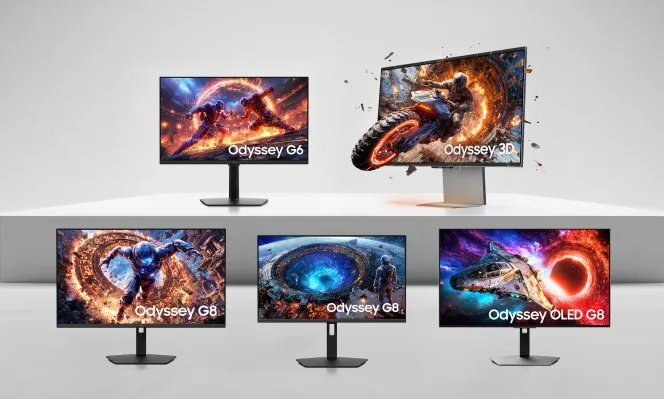
Samsung pushes gaming monitors into new territory with 6K 3D and 1,040Hz refresh rates
Samsung has unveiled its 2026 Odyssey gaming monitor lineup, introducing five new models that raise the ceiling on both resolution and speed. The range is led by the company’s first 6K glasses-free 3D display and complemented by an esports-focused panel that can reach 1,040Hz in a high-speed mode.
The announcement, published by Samsung, positions the new Odyssey family as a blend of spectacle and competitive performance: immersive 3D without a headset, ultra-high pixel density for creators, and refresh rates far beyond what most PCs and consoles target today.
Samsung says the full 2026 Odyssey lineup will be showcased at CES 2026 in Las Vegas (Jan. 6–9), where attendees can try the displays firsthand.
The headline act: Odyssey 3D brings glasses-free 6K to a 32-inch monitor
The centerpiece is the 32-inch Odyssey 3D (G90XH), which Samsung calls the world’s first monitor to combine 6K resolution (6,144 × 3,456) with glasses-free 3D.
How Samsung’s glasses-free 3D works
Samsung’s approach relies on real-time eye tracking to adjust depth and perspective based on the viewer’s position. In practical terms, the monitor attempts to maintain the 3D effect as you move, aiming to reduce the “sweet spot” limitations that have historically plagued autostereoscopic (glasses-free) displays.
In addition, Samsung says the Odyssey 3D supports:
- 2D → 3D conversion for compatible content
- A growing list of supported game titles with optimized 3D effects, developed in collaboration with game studios
Samsung highlighted titles including The First Berserker: Khazan, Lies of P: Overture, and Stellar Blade as examples that will offer enhanced dimensionality—improving perceived separation between objects, terrain depth, and distance cues beyond conventional 2D.
Performance specs: 165Hz native, up to 330Hz via Dual Mode
Despite the high resolution, Samsung is still emphasizing speed:
- 165Hz refresh rate (native)
- Up to 330Hz using Dual Mode (at 3K resolution)
- 1ms GtG response time
- Ports: HDMI 2.1 and DisplayPort 2.1
This “Dual Mode” concept appears across the lineup: a way to trade resolution for a higher refresh rate, depending on the game and the GPU load.
Odyssey G6: Samsung claims a world-first 1,040Hz gaming monitor
For competitive players, the most eye-catching number is attached to the 27-inch Odyssey G6 (G60H). Samsung says it is the world’s first gaming monitor capable of 1,040Hz refresh via Dual Mode.
What you need to know about the 1,040Hz figure
The fine print matters:
- The panel’s native resolution is QHD (2,560 × 1,440)
- It supports up to 600Hz at native QHD
- The 1,040Hz mode is enabled only when operating in HD resolution via Dual Mode
That said, even 600Hz at QHD is a significant step beyond today’s mainstream esports displays (typically 240Hz to 360Hz), underscoring Samsung’s intent to compete at the extreme end of motion clarity.
VRR support and gaming features
Samsung lists broad variable refresh rate support for the G6:
- AMD FreeSync Premium Pro
- NVIDIA G-Sync Compatible (certification noted as expected at launch)
- HDR10+ Gaming
Connectivity features HDMI 2.1 and DisplayPort 2.1, aligning with the bandwidth requirements of high-refresh-rate gaming.
Odyssey G8 expands: 6K, 5K, and 4K QD-OLED options
Samsung is also expanding the Odyssey G8 family in 2026, offering three distinct models aimed at different preferences—pixel density, speed, and contrast.
Odyssey G8 (G80HS): 32-inch 6K with Dual Mode
Samsung calls the 32-inch Odyssey G8 (G80HS) the industry’s first 6K gaming monitor.
Key specs:
- 6K (6,144 × 3,456)
- 165Hz native
- Up to 330Hz in 3K via Dual Mode
- Panel: IPS
- Ports: HDMI 2.1, DisplayPort 2.1
This model appears designed for users who want a high-resolution workspace for creation and productivity but still want high refresh rates for gaming when switching to a lower resolution mode.
Odyssey G8 (G80HF): 27-inch 5K with a 360Hz QHD mode
The 27-inch Odyssey G8 (G80HF) targets users who want sharper-than-4K detail in a smaller format.
Key specs:
- 5K (5,120 × 2,880)
- 180Hz native
- Up to 360Hz in QHD via Dual Mode
- Panel: IPS
- Ports: HDMI 2.1, DisplayPort 2.1
A 27-inch 5K panel also sits at an interesting intersection for creators and gamers: high pixel density for text and UI work, with a performance-focused mode for titles where resolution scaling is acceptable.
Odyssey OLED G8 (G80SH): 32-inch 4K QD-OLED at 240Hz
For buyers who prioritize contrast and cinematic visuals, Samsung’s 32-inch Odyssey OLED G8 (G80SH) uses a 4K QD-OLED panel.
Key specs and features:
- 4K (3,840 × 2,160)
- 240Hz refresh rate
- Glare-free viewing
- 300-nit brightness (as stated by Samsung)
- VESA DisplayHDR™ True Black 500 certification
- HDR10+ Gaming
- Ports: HDMI 2.1, DisplayPort 2.1 (UHBR20), USB-C (98W)
The inclusion of DisplayPort 2.1 UHBR20 (up to 80Gbps bandwidth) is notable for users trying to run high refresh rates with HDR and VRR simultaneously, particularly at 4K.
Samsung also lists AMD FreeSync Premium Pro and NVIDIA G-Sync Compatible support across all three G8 models for tear-free playback.
Why 6K and 1,000Hz matter—and what could limit them
Samsung’s new Odyssey range is a signal of where the high-end monitor market is headed: more pixels, more frames, and new forms of immersion.
The 6K question: GPU horsepower and real-world use
A 6K panel (6,144 × 3,456) contains roughly 21.2 million pixels, which is substantially above 4K’s 8.3 million. Even top-tier GPUs can struggle to push modern games at high settings at 4K—so 6K gaming at 165Hz is likely aspirational for most users.
However, 6K can be immediately valuable for:
- Content creation timelines and multi-window workflows
- High-resolution photo/video work where UI and preview can coexist comfortably
- Downscaled gaming (render lower, display sharper) or using Dual Mode for high refresh
The 1,040Hz question: content, pipelines, and esports priorities
At extreme refresh rates, the bottleneck often shifts from the panel to the ecosystem:
- The game must render at extremely high frame rates
- CPU performance and latency become critical
- Display interfaces and settings must support the mode cleanly
Still, the G6’s positioning is clear: it is built for motion clarity and responsiveness above all else—an extension of the arms race already seen in 360Hz and 500Hz esports monitors.
Market context: Samsung cites leadership in high-refresh gaming monitors
Samsung points to IDC data indicating it leads the global gaming monitor market for displays with refresh rates above 144Hz, with an 18.8% revenue share (IDC Worldwide Quarterly Gaming Tracker, Q3 2025). With the 2026 Odyssey lineup, Samsung says it is aiming to maintain its No. 1 position for a seventh consecutive year.
Specs at a glance: Samsung’s 2026 Odyssey lineup
Below are the key specifications Samsung disclosed.
Odyssey 3D (G90XH)
- Size: 32-inch
- Resolution: 6K (6,144 × 3,456)
- Panel: IPS
- Refresh rate: 165Hz, 330Hz (Dual Mode 3K)
- Response: 1ms GtG
- Ports: HDMI 2.1, DP 2.1
- Features: glasses-free 3D, eye tracking, 2D→3D conversion
Odyssey G6 (G60H)
- Size: 27-inch
- Resolution: QHD (2,560 × 1,440)
- Panel: IPS
- Refresh rate: 600Hz, 1,040Hz (Dual Mode HD)
- Ports: HDMI 2.1, DP 2.1
- Features: FreeSync Premium Pro, G-Sync Compatible, HDR10+ Gaming
Odyssey G8 (G80HS)
- Size: 32-inch
- Resolution: 6K (6,144 × 3,456)
- Panel: IPS
- Refresh rate: 165Hz, 330Hz (Dual Mode 3K)
- Ports: HDMI 2.1, DP 2.1
Odyssey G8 (G80HF)
- Size: 27-inch
- Resolution: 5K (5,120 × 2,880)
- Panel: IPS
- Refresh rate: 180Hz, 360Hz (Dual Mode QHD)
- Ports: HDMI 2.1, DP 2.1
Odyssey OLED G8 (G80SH)
- Size: 32-inch
- Resolution: 4K (3,840 × 2,160)
- Panel: QD-OLED
- Refresh rate: 240Hz
- Ports: HDMI 2.1, DP 2.1 (UHBR20), USB-C (98W)
- Features: Glare Free, VESA DisplayHDR True Black 500, HDR10+ Gaming
What to watch at CES 2026: demos, pricing, and compatibility details
Samsung has not detailed pricing or regional availability in the announcement, so CES 2026 will likely be the venue where buyers learn:
- Launch timing by market
- Pricing tiers between IPS 6K/5K and QD-OLED models
- How Dual Mode is configured (OSD presets, scaling behavior, input lag impact)
- The breadth of game support for the Odyssey 3D’s optimized titles, plus how well 2D→3D conversion works in practice
For prospective buyers, it will also be important to confirm GPU and cable requirements for high-bandwidth modes, especially on DisplayPort 2.1.
Ecosystem note: Samsung’s broader hardware and software push
Samsung’s monitor roadmap arrives as the company continues to evolve its broader product ecosystem across displays, PCs, and mobile devices. For readers following Samsung’s software strategy—particularly how UI features and gaming-oriented optimizations land across devices—our internal guide, Samsung One UI 7.0: Everything You Need to Know About the Latest Update, provides context on the company’s latest platform direction.
Bottom line
Samsung’s 2026 Odyssey lineup is an aggressive bet that the next wave of premium monitors will be defined by extremes: 6K resolution for detail and productivity, 1,000Hz-class refresh rates for competitive motion clarity, and glasses-free 3D as a new differentiator for immersion.
If Samsung can deliver strong real-world performance—especially for eye tracking stability, 3D comfort, and practical Dual Mode switching—the new Odyssey family could set the tone for high-end gaming displays in 2026.
Official links: Learn more from Samsung Electronics and monitor certification details via VESA.




Leave a Reply